Seoul National University Hospital Identifies Risk Factors for Peripartum Cerebrovascular Events in Women with Moyamoya Disease
- The risk of cerebrovascular events (CVEs) significantly increases if cerebral hemodynamics are unstable or if necessary revascularization surgery has not been completed before pregnancy
- The study proposed clinical management protocols and screening criteria for high-risk groups...Delivery methods and anesthesia types showed no significant correlation with CVEs
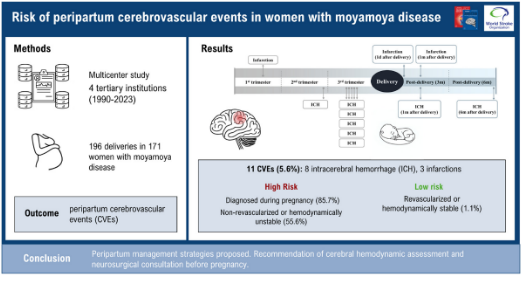
[Figure 1] Incidence of Peripartum Stroke in Mothers with Moyamoya Disease and Differences by Risk Group. The incidence of peripartum stroke was significantly higher in mothers who had unstable cerebral hemodynamics prior to pregnancy or who had not undergone cerebral revascularization.
Key factors influencing the risk of stroke during the peripartum period* in mothers with Moyamoya disease (MMD) have been identified. The study found that the risk of stroke significantly increases if cerebral blood flow was not sufficiently stable, or if necessary revascularization surgery was not completed prior to pregnancy. The research team stated that assessing the status of cerebral hemodynamics before pregnancy and administering treatment to stabilize it, if necessary, can help lower the risk of stroke during pregnancy and childbirth.
*Peripartum period: Includes the duration of pregnancy and up to six months after delivery.
Moyamoya disease is a rare, incurable disease in which the major blood vessels supplying blood to the cerebrum gradually narrow or become blocked. During pregnancy, rapid physiological changes such as increased blood volume, hormonal shifts, and blood pressure fluctuations place a burden on cerebral hemodynamics, which can increase the risk of stroke in pregnant women. However, there has been a lack of large-scale, systematic studies analyzing these risk factors for stroke before and after childbirth.
A research team led by Professor Seung-Ki Kim of Seoul National University Hospital and Professors Soo-Young Oh and Jong-Seok Lee of Samsung Seoul Hospital announced the results of a retrospective multi-center study on the 16th. This study analyzed the incidence of stroke during the peripartum period and major risk factors in mothers with Moyamoya disease at four tertiary hospitals.
This study included 196 birth records from 171 mothers with MMD collected between 1990 and 2023 at Seoul National University Hospital, Bundang Seoul National University Hospital, Samsung Medical Center, and Asan Medical Center.
The research team analyzed the timing of MMD diagnosis, pre-pregnancy cerebral hemodynamics, and whether revascularization was performed, based on the occurrence of peripartum stroke. They also examined the impact of delivery methods and anesthesia types on stroke occurrence and evaluated key risk factors using univariate and multivariate logistic regression analyses.
The analysis showed that stroke occurred in 5.6% of all peripartum cases. In particular, the incidence was as high as 85.7% among mothers newly diagnosed with MMD during pregnancy(7 people). Furthermore, 55.6% of mothers with unstable pre-pregnancy hemodynamics or incomplete revascularization experienced a stroke, leading the team to classify them as a "high-risk group."
In contrast, the stroke incidence rate was only 1.1% for mothers who had stable cerebral hemodynamics or had completed necessary revascularization before pregnancy. This indicates that the risk of peripartum stroke is more closely tied to how stably cerebral blood flow was maintained before pregnancy.
The logistic regression analysis also confirmed that "unstable pre-pregnancy hemodynamics or incomplete revascularization" is an independent risk factor for peripartum stroke. Conversely, the mode of delivery and the type of anesthesia used showed no statistically significant correlation with stroke occurrence.
When peripartum stroke occurred, the impact on both mother and fetus was significant. Among mothers who experienced a stroke, 36.4% suffered permanent neurological deficits, and fetal loss was observed in 18.2% of those cases.
Based on these findings, the research team proposed a clinical management protocol for pregnant women with MMD. The protocol categorizes high-risk patients based on pre-pregnancy blood flow evaluation and the completion of revascularization, emphasizing the need for meticulous management to minimize blood pressure and respiratory fluctuations for high-risk mothers during the peripartum period.
Professor Seung-Ki Kim(Department of Neurosurgery, SNUH) said "This study systematically identifies the risk factors and management directions for mothers with Moyamoya disease, providing a practical reference for clinical settings"
This study was conducted with the support of the Lee Kun-hee Child Care & Rare Disease Project and was published in the latest issue of the ‘International Journal of Stroke.’

[From left] Professor Seung-Ki Kim (Seoul National University Hospital), Professor Soo-young Oh, and Professor Jong-seok Lee (Samsung Medical Center)