Since its establishment in 1946 as the first Department of Urology in Korea, the Department of Urology at Seoul National University Hospital (SNUH) has continuously provided the highest level of clinical care and research for various urologic diseases. With the establishment of the Cancer Research Institute in 1983, the Cancer Research Building in 2000, and the Cancer Hospital in 2011, SNUH has accumulated unparalleled clinical experience and research achievements in the field of urologic oncology. In particular, a highly structured and specialized multidisciplinary system has been established for the management of complex, advanced, and metastatic urologic cancers.
Building upon these accomplishments, the Department of Urology at SNUH was ranked second in the world by Newsweek in its 2025 World’s Best Specialized Hospitals ranking, underscoring its position as a globally leading institution in the field of urology.
A patient-friendly, patient-specific treatment system
The diagnosis and treatment of urinary cancer involves several steps. The urinary cancer center operates a counseling nurse system for patients to receive help related to hospital visits and discharges including medical care procedures. When visiting the hospital regularly after surgery, we try to minimize the hassle of multiple hospital visits by ensuring that you can receive treatment from as many related medical departments as possible on the same day.
Integrative Care by Top-notch Medical Staff
The Urinary Cancer Center discusses treatment policies according to the characteristics of each patient in various ways through organized cooperation with the medical staff of the Department of Urology, Hemato Oncology, Radiation Oncology, Radiology, Pathology, and Nuclear Medicine. Moreover, we provide patient-centered, personalized, and integrated care by implementing ‘FIRST Collaborative Care,’ where each department faculty and the nurses in charge gather to meet patients once a week.
World-class Research-oriented Hospital
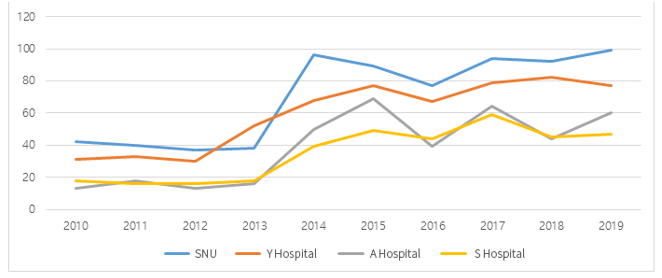
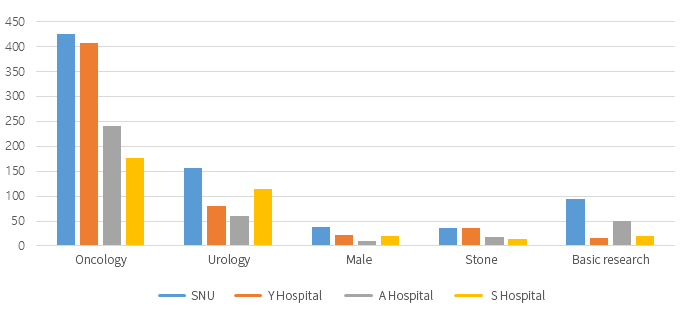
We conduct research activities such as conducting dozens of government- and private- managed research publishing research papers per year, and participating in international multicenter clinical trials for various immunotherapy and anticancer drugs. By participating in these international multicenter clinical trials at the Urinary Cancer Center, we are also providing opportunities to various patients to use new drugs
◎ Number of SCI Paper Publication by Year (2010-2019)
◎ Number of SCI Paper Publication by Field (2010-2019)
Trustworthy Medical Staff and Standardized Cutting-edge Treatment
The Urinary Cancer Center has steadily performed many surgeries for various urological tumors such as prostate cancer, kidney cancer, bladder cancer, testicular cancer, and penile cancer for decades, and boasts long-accumulated know-hows and excellent surgical results. Various surgical methods including endoscopy, laparoscopy, single laparoscopy, and robotic surgery have been introduced and applied. Besides these methods, we performed single incision laparoscopic radical nephrectomy for kidney cancer for the first time in Korea, and also performed single incision laparoscopic nephrectomy for kidney cancer for the first time in the world. With long-term experience in cancer treatment, we are improving the quality of care and patient safety.
Medical Service using State-of-the-art Technology
Robotic surgery enables both wide and three-dimensional vision and precise surgery. Besides this, robot surgery has the advantage of improving surgical efficacy while minimizing sequelae and complications. The Urinary Cancer Center of Seoul National University Cancer Hospital applies robotic surgery to various cancers such as prostate cancer, kidney cancer, and bladder cancer.
Current Status of Major Cancer Surgery
For most urinary cancer patients, precision medicine is implemented using the First Cancer Panel (a type of Cancer Gene Panel) and Syapse system. In the case of prostate cancer, about 560 prostate cancer surgeries are performed annually, and 94.8% are performed by robotic surgery. We are applying the latest pelvic nerve monitoring device and pelvic hypothermia surgery to preserve erection function and prevent urinary incontinence.
In the case of bladder cancer, 1,000 cases of bladder cancer are performed annually, 90 cases of radical bladder extraction are performed annually, and 62.6% are performed by robotic surgery. The proportion of artificial bladder (neobladder) is 79.4% and the proportion of ileal conduit is 20.6%. The partial bladder resection is performed at 9.6%.
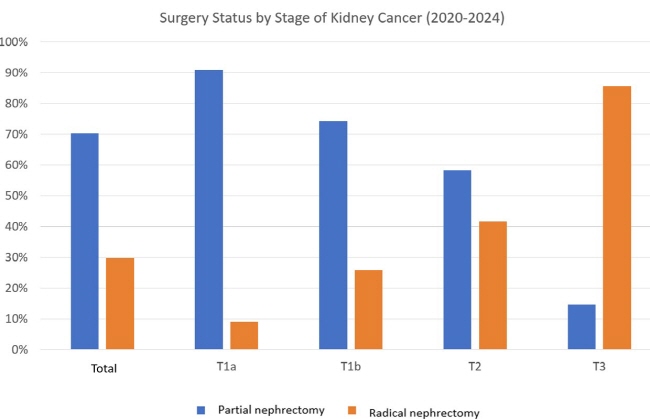
In the case of kidney cancer, 400 kidney cancer operations are performed annually, 90.6% for the T1a (<4cm), 74.5% for the T1b (<7cm), and 37.5% for the T2 and 14.3% for the T3 stage.
About 280 people have registered metastatic kidney cancer and are being followed up. Approximately 20 patients undergo cytoreductive nephrectomy each year at our institution.
◎ Surgery Status by Stage of Kidney Cancer (2020-2024)