Seoul National University Hospital: Cancer Patients Who Learned ‘How to Comfort Themselves’ Show Reduced Demoralization
- ‘Come With You,’ a self-compassion psychological program, developed to help patients treat themselves with warmth rather than self-criticism
- Greatest improvement in demoralization observed one month after participation; spiritual well-being, anxiety, and depression also showed positive changes
Among cancer patients who participated in "Come With You"—a psychological program developed by a research team at Seoul National University Hospital—approximately 7 out of 10 individuals suffering from severe "demoralization" (a state characterized by a loss of meaning in life and a sense of helplessness) showed marked improvement when evaluated one month later. "Come With You" is a five-session program designed to foster "self-compassion"—the practice of treating oneself with warmth and kindness rather than self-criticism during difficult times.
According to the 2023 National Cancer Registry Statistics from the Ministry of Health and Welfare, there are 2.73 million cancer survivors in South Korea—roughly 1 in every 19 people—with a 73.7% five-year relative survival rate for those diagnosed within the last five years. However, throughout the treatment process, cancer patients often grapple not only with physical pain but also with profound existential concerns regarding the meaning of life, death, and an uncertain future. "Demoralization" refers to a state in which individuals lose their sense of purpose and the strength to persevere, often plagued by thoughts such as, "Why did this happen to me?" or "Is it even worth living like this?" This condition is distinct from clinical depression—which involves a persistent low mood and a loss of interest—and some patients may experience severe demoralization even in the absence of depression.
Existing psychological interventions have primarily focused on reducing anxiety and depression. While some research has indicated that cultivating "self-compassion"—treating oneself with warmth during challenging periods—can help alleviate anxiety and depression, the impact of such an approach on demoralization or "spiritual well-being" (a sense of meaning, peace, and stability derived from one’s beliefs or faith) has not been sufficiently studied.
A research team led by Professor Hye-Yoon Park and Clinical Fellow Yeon-Kyu Choi from the Department of Neuropsychiatry at Seoul National University Hospital (SNUH) announced on the 30th that they have developed a program called "Compassion With You (COMwithU)" and confirmed its feasibility and preliminary efficacy. COMwithU is one of approximately 20 non-pharmacological therapeutic programs developed by the "Mind the SHIM (SNUH Health In Mind) Center" at SNUH, which opened in 2023. Through this program, mental health professionals meet with patients one-on-one for five 60-minute sessions—either in person or via video call—to guide them in practicing self-compassion and compassion toward others.
The research team conducted a single-arm study at SNUH from May 2024 to December 2025. Out of 44 cancer patients who began the program, 37 (84.1%) completed at least three of the five sessions. Participants were assessed using surveys before the program, immediately after its conclusion, and one month later. The assessments covered several areas: ▲Demoralization (DS-II) ▲Spiritual well-being (FACIT-Sp) ▲Anxiety (HADS-A) ▲Depression (HADS-D) ▲Self-compassion (SCS) ▲Intolerance of uncertainty (the degree to which an individual struggles to endure uncertain situations; IUS-12).
The analysis revealed statistically significant improvements in scores for demoralization, spiritual well-being, anxiety, depression, and self-compassion. Most of these changes were observed immediately after the program and were sustained thereafter. Notably, "demoralization" showed the most significant degree of improvement when evaluated one month after the program's completion.
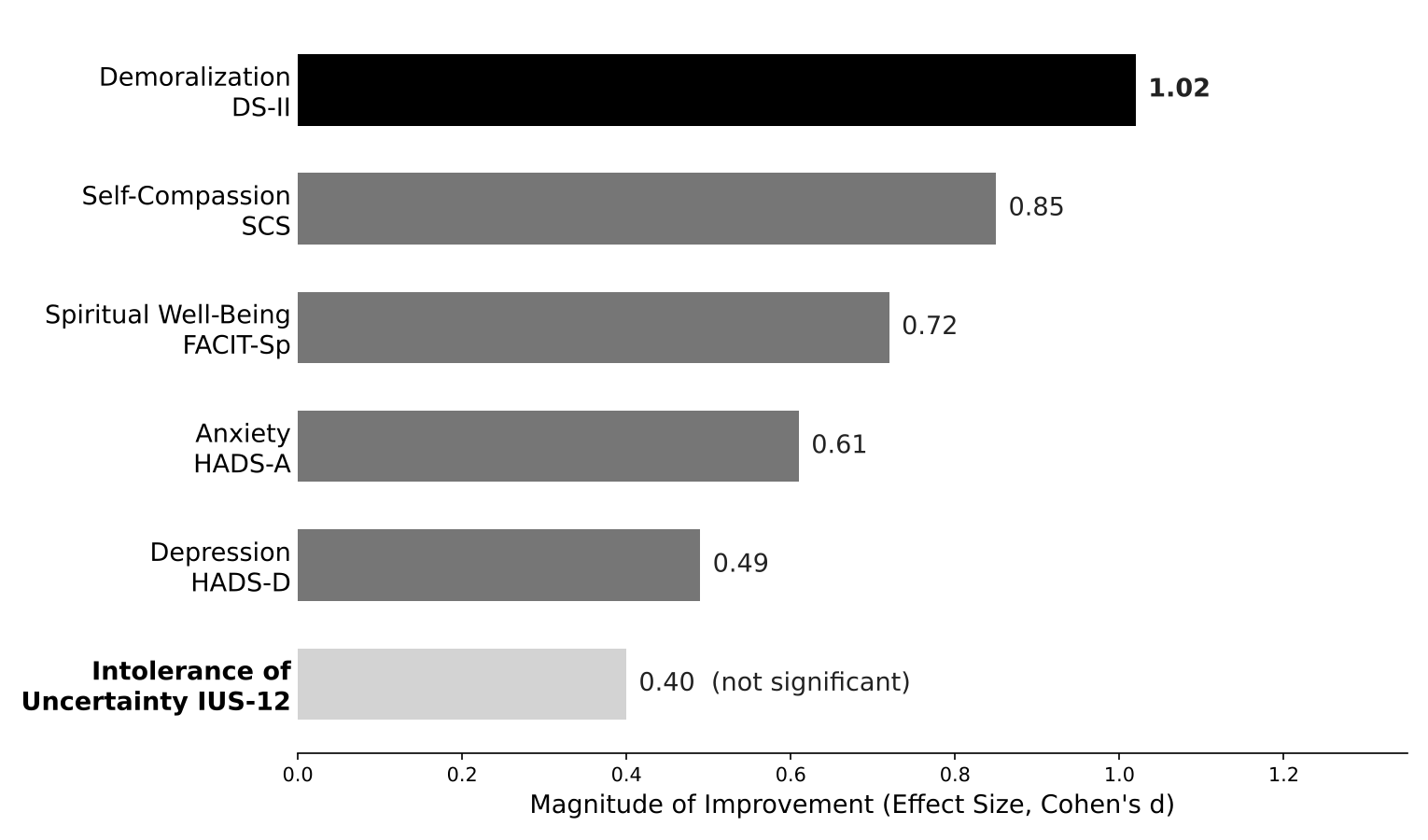
[Figure 1] Extent of improvement by metric one month after the program. The improvement in demoralization was the most significant, and all metrics—with the exception of intolerance of uncertainty—showed statistically significant improvement.
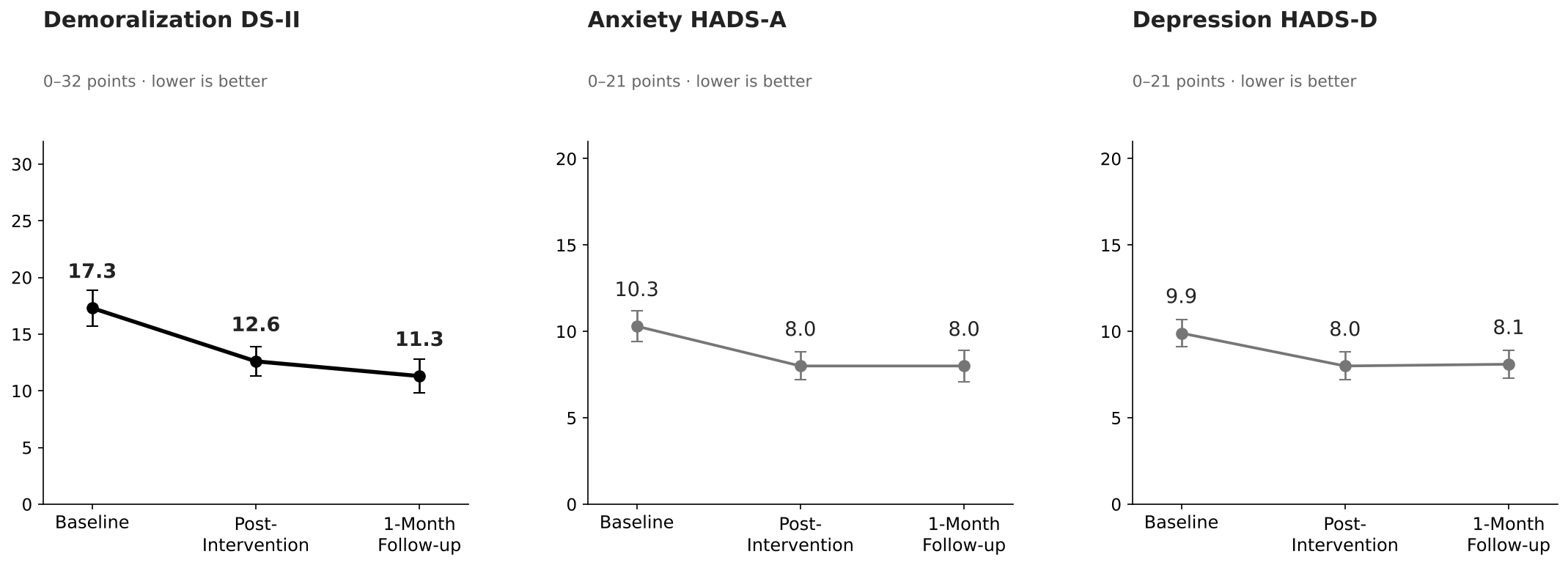
[Figure 2] Changes in psychological indicators before, immediately after, and one month after participating in 'Come With You.' Scores for demoralization, anxiety, and depression all decreased immediately following the program and remained lower one month later (statistically significant changes).
The mean score on the demoralization scale decreased from 17.3 at baseline to 12.6 immediately after the program, and further to 11.3 one month later. Among the 25 participants who initially exhibited clinically significant levels of demoralization (a score of 10 or higher) and completed the one-month follow-up assessment, 68% (17 individuals) showed improvement exceeding the margin of measurement error, and 56% (14 individuals) saw their scores drop below 10—a change considered clinically significant. No patients experienced a marked worsening of demoralization.
The mean score for spiritual well-being rose from 21.2 to 28.8 immediately following the program and remained at a similar level one month later; the degree of improvement at the one-month mark was greater than that observed for anxiety or depression. Similarly, the mean score for self-compassion increased significantly in statistical terms—from 76.8 at baseline to 85.4 immediately after the program, and to 87.3 one month later. In contrast, there was no notable change in the participants' level of intolerance for uncertainty. The program received an average rating of 4.63 out of 5 for its perceived helpfulness, and no adverse events were reported during the study period.
Lead author and clinical fellow Yeon-Kyu Choi emphasized, “When cancer patients open up about their struggles in the clinic, the core of their concern—often more pressing than depression or insomnia—is the question of what they should live for; this is a topic that even mental health professionals find challenging to address.” He added, “The significance of developing ‘COMwithU’ lies in the fact that as patients shift their attitude toward themselves, they experience a transformation that goes beyond merely overcoming depression and anxiety—they discover new meaning in life and the strength to persevere.”
Corresponding author Professor Hye-Yoon Park explained, “Considering that many Korean cancer patients struggle to articulate their emotions and often blame themselves for their illness, ‘COMwithU’ was designed to help them learn self-compassion in a gradual, step-by-step manner through their relationship with a therapist.” She added, “We are currently conducting a multicenter randomized controlled trial. Once its efficacy is proven, we plan to formalize training for therapists so that the program can be made accessible to a broader range of cancer patients.”
This research was supported by SinsagoBooks Co., Ltd.—which sponsors the Mind the SHIM Center—and the National Research Foundation of Korea. The findings were published in a recent issue of the international journal ‘Psycho-Oncology’.

[From left] Professor Hye-Yoon Park and Clinical Fellow Yeon-Kyu Choi, Department of Neuropsychiatry, Seoul National University Hospital