SNUH, 'Depressed Employees Show Marked Absence and Decreased Work Efficiency… Health Factors Associated with Productivity Loss Vary by Age'
- Survey analysis of 1,000 Korean employees… Comparing the associations of depressive symptoms and health status with work productivity loss across age groups (<35 vs 35 years span>
- Under 35s linked with physical and social health; 35 and older linked with mental and spiritual health
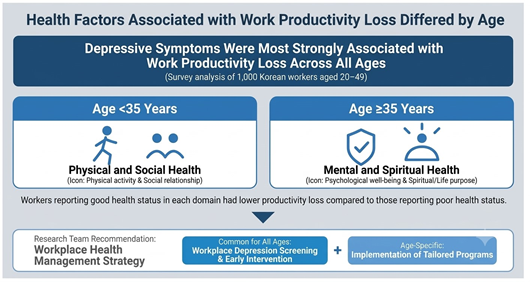
[Image] Association Between Age-Specific Health Factors and Work Productivity Loss Among Employees
Employees experiencing depressive symptoms were significantly more likely to be absent or suffer from reduced work efficiency even when present at work compared to those without depression. Specifically, the association with depressive symptoms was most prominent for absenteeism among workers under 35 years of age, and for presenteeism (reduced productivity while at work) among workers aged 35 and older. Health factors associated with work productivity loss also varied by age: physical and social health were distinctly relevant for those under 35, whereas mental and spiritual health were key for those aged 35 and older.
A joint research team led by Professor Yun Young-ho from the Department of Family Medicine at Seoul National University Hospital (SNUH) and Professor Jung Joo-yeon from the Department of Tourism & Wellness at Hankuk University of Foreign Studies announced on the 27th the results of a cross-sectional study analyzing how depression and physical, mental, social, and spiritual health status relate to work productivity loss, categorized into two age groups (<35 vs 35 years based on a survey of 1 000 workers aged 20 49 across various industries conducted in January 2024 span>
The study included 489 participants under age 35 and 511 aged 35 and older. Depressive symptoms were defined as a Patient Health Questionnaire-9 (PHQ-9) score of 10 or higher. Work productivity loss was measured across three parameters: ▲Absenteeism (proportion of working time missed due to health problems), ▲Presenteeism (extent to which health problems impaired work performance while at work), and ▲Overall work impairment (a combined measure of absenteeism and presenteeism), based on self-reported health assessments. Participants scoring at or above the group average for each indicator were classified as having productivity loss.
The analysis revealed that in both age groups, depressive symptoms were most strongly associated with absenteeism, presenteeism, and overall work impairment. This trend persisted even after adjusting for potential confounders such as sex, education, and income. Workers with depressive symptoms had significantly higher odds of productivity loss compared to those without. The adjusted odds ratios (aOR) were 5.42 for absenteeism, 2.13 for presenteeism, and 2.43 for overall work impairment in the <35 age group and 2 89 for absenteeism 4 78 for presenteeism and 4 84 for overall work impairment in the 35 age group span>
While workers reporting good health status generally showed lower odds of productivity loss than those in poor health, the specific health domains associated with productivity loss differed by age after adjusting for other factors. Among workers under 35, good physical health was associated with nearly halved odds of presenteeism (aOR 0.52) and overall work impairment (aOR 0.52), while good social health halved the odds of overall work impairment (aOR 0.50). Good mental health was associated with lower presenteeism (aOR 0.59).
In contrast, among workers aged 35 and older, associations with mental and spiritual health were particularly pronounced. Good mental health reduced the odds of presenteeism and overall work impairment to approximately one-third (aOR 0.32 for both), while good spiritual health reduced the odds of absenteeism by more than half (aOR 0.41). The research team interpreted these findings to suggest that physical vitality and social relationships within an organization may be major factors for workers under 35, whereas psychological resources and life purpose play a central role for those aged 35 and older.
Comparing the two groups, the prevalence of depressive symptoms was higher in the <35 group 33 1 than in the 35 group 27 0 The proportion of working time lost due to health problems was also about twice as high in the younger group mean 6 8 vs 3 3 with higher averages also observed for presenteeism 36 3 vs 32 9 and overall work impairment 39 5 vs 34 4 span>
Given that depressive symptoms are strongly associated with productivity loss across all ages, the research team emphasized the need for company-wide workplace depression screening, early intervention, and anti-stigma initiatives for mental health, combined with age-tailored wellness programs. Physical activity programs and team-building or peer mentoring initiatives may be suitable for employees under 35, whereas stress management, mindfulness, and purpose-in-life programs may be more effective for those aged 35 and older.
Professor Jung Joo-yeon (Department of Tourism & Wellness, Hankuk University of Foreign Studies) stated, "Because the health factors related to work productivity loss differ by age, companies need tailored wellness strategies aligned with age-specific characteristics rather than a one-size-fits-all approach.“
Professor Yun Young-ho (Director of SNUH Gangnam Center) added, "Depression is the factor most clearly linked to reduced workplace productivity. Rather than viewing employee health solely as an individual matter or a corporate fringe benefit, organizations must shift their perception toward investing in health to boost productivity and competitiveness.“
The findings of this study were published in the latest issue of the 'Journal of Occupational and Environmental Medicine (JOEM)', an international journal in the field of occupational and environmental health.

[From left] Professor Yun Young-ho, Department of Family Medicine, Seoul National University Hospital; Professor Jung Joo-yeon, Department of Tourism & Wellness, Hankuk University of Foreign Studies