SGLT2 Inhibitor Prescription Associated with Higher Rate of Independent Living in Diabetic Stroke Patients Following Endovascular Thrombectomy
- Analysis of 429 patients across 4 institutions in Korea·Switzerland· Italy, including Seoul National University Hospital and Asan Medical Center
- Proportion of independent living at 3 months poststroke: 65.1% in the SGLT2 inhibitor group vs. 45.3% in the non-prescription group (approx. 20%p higher, after adjustment)
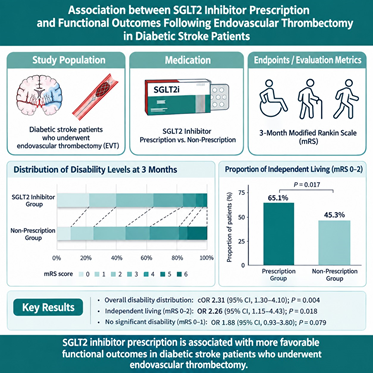
[Image] Proportion of Independent Living at 3 Months According to SGLT2 Inhibitor Prescription Status in Diabetic Stroke Patients Who Underwent Endovascular Thrombectomy
For diabetic patients with acute ischemic stroke who continue to experience neurological deficits despite successful endovascular thrombectomy (EVT)—a procedure to clear blocked cerebral arteries—diabetes medications may offer a new avenue for recovery. A recent study revealed that among stroke patients who underwent EVT, those prescribed sodium-glucose cotransporter 2 (SGLT2) inhibitors showed an approximately 20% percentage point higher rate of living independently without assistance at three months compared to those not prescribed the medication.
A joint research team led by Professor Kim Jeong-min from the Department of Neurology at Seoul National University Hospital and Professor Yang Wook-jin from the Department of Neurology at Asan Medical Center announced on the 16th that they confirmed these findings through a retrospective analysis of 429 diabetic stroke patients who underwent endovascular thrombectomy across four medical institutions in Korea·Switzerland·Italy between January 2020 and March 2025.
*Endovascular thrombectomy refers to a procedure where a catheter is inserted into blood vessels to remove blood clots.
Globally, approximately 12 million new stroke cases occur each year. Because once-damaged nerve cells are difficult to regenerate, rehabilitation therapy is often the primary recourse. Amid this challenge, the research team investigated whether SGLT2 inhibitors—antidiabetic medications that lower blood glucose by promoting urinary glucose excretion and are increasingly used due to proven cardiovascular and renal protective effects in heart failure and chronic kidney disease patients—could also aid poststroke recovery. Notably, the prescription rate of SGLT2 inhibitors among the study cohort increased from 4.5% in 2020 to 21.1% in 2024–2025.
However, clinical evidence regarding their impact on poststroke recovery remained limited. Although the research team previously reported an association between SGLT2 inhibitor use and recovery in a single-center study, most subjects were patients with mild strokes, and no prior studies had separately analyzed moderate-to-severe patients requiring EVT. The current study expanded the cohort to include moderate-to-severe patients across four centers: Seoul National University Hospital, Asan Medical Center, Maggiore Hospital of Bologna (Italy), and Lausanne University Hospital (Switzerland).
The average age of the analyzed patients was 73.5 years, and the median baseline NIHSS score representing stroke severity was 12, indicating moderate-to-severe illness. The research team divided the patients into an SGLT2 inhibitor prescription group (51 patients) and a control group (378 patients) based on discharge medications. Their disability levels at 3 months were compared using mRS, which ranges from 0 (no symptoms) to 6 (death), with lower scores indicating milder disability. Differences in age, sex, underlying comorbidities, and stroke severity between the two groups were adjusted using statistical models.
The analysis revealed that after adjustment, mRS score was lower in the SGLT2 inhibitor group (median score of 2) compared to the control group (median score of 3), indicating overall lighter disability in the prescription group (common odds ratio, 2.31; 95% CI, 1.30–4.10). The proportion of patients achieving an mRS score of 0 to 2—defined as living independently without assistance—was 65.1% in the prescription group and 45.3% in the control group, marking a difference of approximately 20% percentage points (odds ratio, 2.26; 95% CI, 1.15–4.43). This corresponds to roughly 6 to 7 out of 10 patients in the prescription group versus 4 to 5 out of 10 in the control group.
These findings remained consistent across alternative statistical adjustment methods, including inverse probability of treatment weighting and propensity score matching, and subgroup analyses stratified by age, sex, initial stroke severity, and geographic region showed no significant variations in the magnitude of the association.
Professor Yang Wook-jin (Department of Neurology, Asan Medical Center) explained, “At a time when pharmacological treatments to promote functional recovery after stroke are severely limited, this study demonstrates the potential of SGLT2 inhibitors as a novel therapeutic strategy to aid functional recovery in stroke patients.”
Professor Kim Jeong-min (Department of Neurology, Seoul National University Hospital) emphasized, “This is the first multicenter study to confirm the association between SGLT2 inhibitor prescription and better functional outcomes in diabetic stroke patients who underwent endovascular thrombectomy. If underlying neural recovery mechanisms are elucidated through basic research and these results are validated via prospective clinical trials, it could bring about significant changes in diabetes management and recovery care guidelines for stroke patients.”
Meanwhile, this study was supported by the Basic Science Research Program through the National Research Foundation of Korea and the Patient-Centered Clinical Research Coordinating Center funded by the Ministry of Health and Welfare, and was published online in the international journal Stroke (Impact Factor 11.1).

[From left] Professor Kim Jeong-min, Department of Neurology, Seoul National University Hospital; Professor Yang Wook-jin, Department of Neurology, Asan Medical Center