Adults with high-quality diets and sufficient physical activity are 11% less likely to have been hospitalized in the past year.
- A Seoul National University Hospital research team analyzed 37,059 adults; groups meeting only one of the two criteria showed no significant difference in the overall analysis.
- Among adults with sufficient physical activity, the likelihood of hospitalization was lower by 15–18% for those with chronic diseases, 18–22% for women, and 28–30% for those aged 65 and older.
Adults who maintained both high-quality diets and sufficient physical activity were 11% less likely to have been hospitalized in the past year compared to those lacking in both areas. Groups that met only one of the two criteria—either high diet quality or sufficient physical activity—showed no statistically significant difference in the overall analysis.
On the October 14th, a research team led by Professors Min-Seon Park and Kyae-Hyung Kim (along with Clinical Fellow So-Young Kim) of the Department of Family Medicine at Seoul National University Hospital announced these findings after analyzing data from the Korea National Health and Nutrition Examination Survey (2014–2021) regarding the link between diet quality, physical activity, and hospitalization among 37,059 adults aged 20 and older.
As the burden of medical expenses rises due to an aging population, understanding lifestyle habits associated with healthcare utilization—such as hospitalizations—has become increasingly important. While healthy eating habits and consistent physical activity are individually known to benefit health, the relationship between practicing both simultaneously and healthcare utilization has not been fully elucidated.
The research team assessed diet quality using the Korean Healthy Eating Index (KHEI) and categorized participants into "high" and "low" groups based on the median value. Regarding physical activity, participants were classified as the "active group" if their leisure-time activity (including walking) met or exceeded 150 moderate-equivalent minutes per week, the World Health Organization’s recommended threshold (based on moderate-intensity activity, defined as activity causing slight breathlessness), and as the "inactive group" otherwise. By combining these two criteria, the researchers formed four groups—low diet quality/inactive (reference group), high diet quality/inactive, low diet quality/active, and high diet quality/active—and compared self-reported data on hospitalizations over the past year and outpatient visits over the past two weeks.
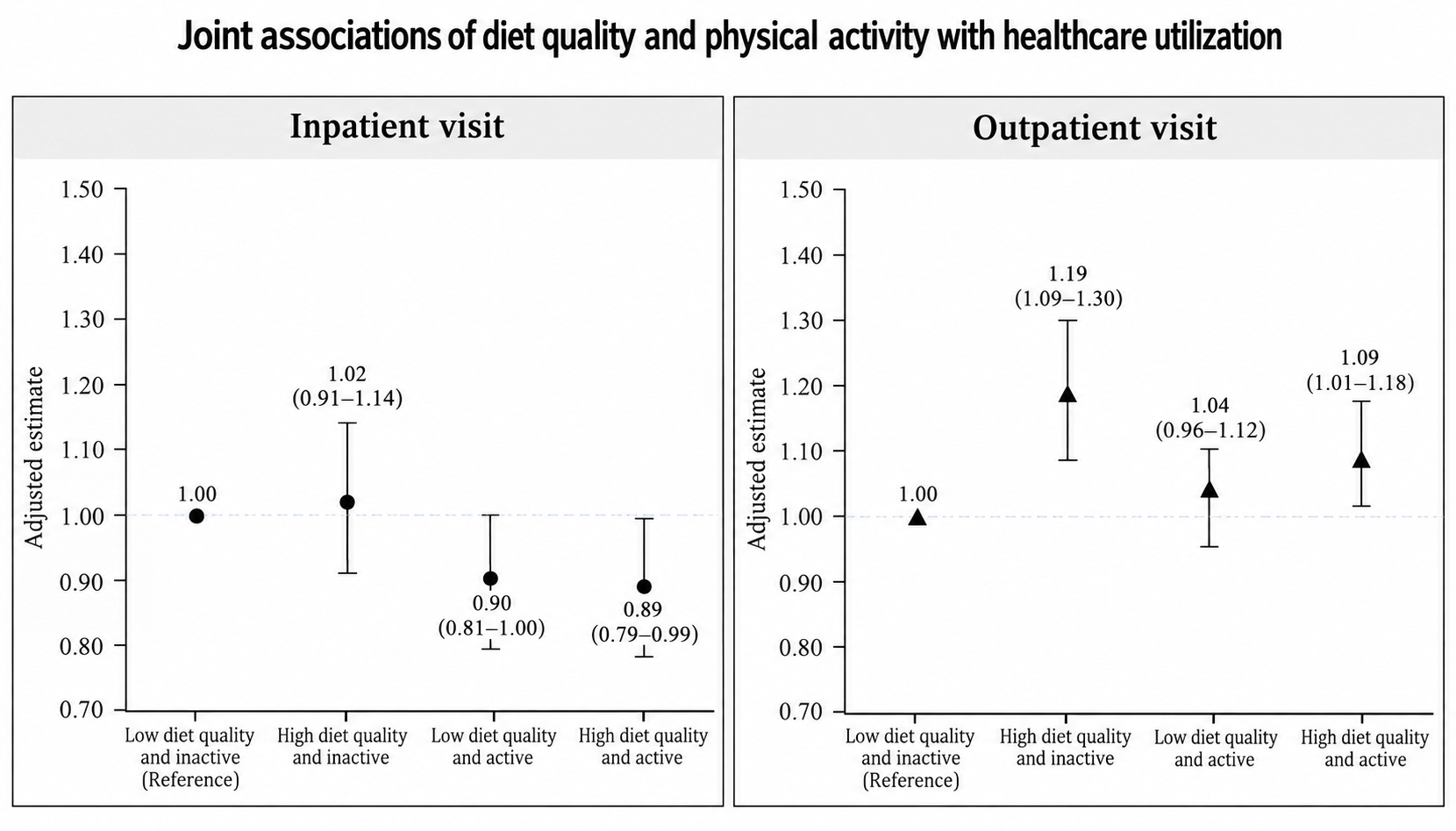
[Figure] Association between healthcare utilization and the combination of diet quality and physical activity
The analysis revealed that the group with high diet quality and high physical activity levels was 11% less likely to have been hospitalized in the past year compared to the reference group (low diet quality and low physical activity) (adjusted OR, 0.89). While the group with low diet quality and high physical activity showed a similar figure (0.90), the result was not statistically significant; the group with high diet quality and low physical activity showed levels comparable to the reference group (1.02).
When stratified by subgroup, individuals with high physical activity levels—regardless of diet quality—showed a lower likelihood of hospitalization: 15–18% lower for those with chronic diseases, 18–22% lower for women, and 28–30% lower for those aged 65 and older. In contrast, no significant association was observed among men, individuals under 65, or those without chronic diseases.
Conversely, outpatient visits were more common among groups with high diet quality. The likelihood of having visited an outpatient clinic in the past two weeks was 19% higher for the high-diet-quality/low-activity group (adjusted OR, 1.19) and 9% higher for the high-diet-quality/high-activity group (1.09). The research team suggested that this might be because individuals with high diet quality are more health-conscious and actively seek medical care, or because those with activity limitations due to underlying conditions require more frequent outpatient visits.
Professor Min-Seon Park (Department of Family Medicine) emphasized the need for an integrated health promotion strategy that targets dietary improvements and increased physical activity simultaneously, noting that "priority should be given to groups with a high burden of hospitalization, such as women, the elderly, and patients with chronic diseases."
However, the research team added that since this was a cross-sectional study, the observed association between lifestyle habits—such as diet and physical activity—and healthcare utilization does not imply direct causation; the possibility of reverse causality (where reduced activity levels result from an underlying illness) cannot be ruled out.
The findings of this study were published in the latest online edition of the international journal *Preventive Medicine Reports*

[Photo from left] Clinical Fellow So-Young Kim, Professors Kyae-Hyung Kim and Min-Seon Park (Department of Familiy Medicine from Seoul National University Hospital)