Migrant Mothers in Korea Not at Higher Risk for Major Obstetric Complications Than Korean-Born Women
- SNUH and SNU College of Medicine analyze 200,000 deliveries in 2022… Risk of major obstetric complications was about 9% lower in migrant women.
- Findings suggest Universal Health Coverage (UHC) serves as a key protective foundation; policy measures needed to address language, cultural, and childcare barriers.
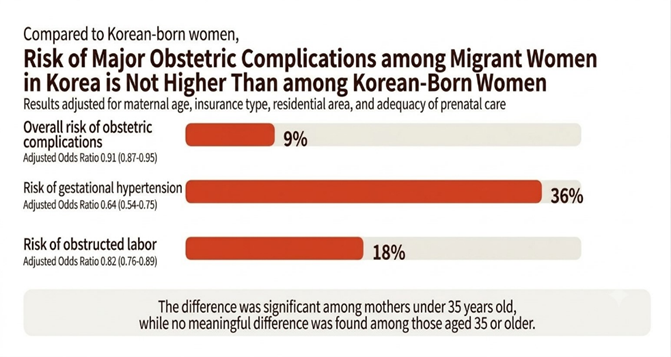
[Figure] Comparison of the risk of major obstetric complications between migrant mothers and Korean-born women
There is a conventional perception that migrant mothers are a high-risk group. However, nationwide analysis results have revealed that the risk of major obstetric complications among migrant women residing in Korea is actually not higher than that of Korean-born women.
Seoul National University Hospital Department of Obstetrics and Gynecology Professor Lee Seung-mi’s team (Dr. Kim Ji-hoi) and Seoul National University College of Medicine Department of Health Policy and Management Professor Lee Jin-yong’s team (Researcher Lee Bo-mi) announced on the 2nd that they confirmed this fact after analyzing Health Insurance Review and Assessment Service (HIRA) claims data for 202,690 deliveries that occurred in Korea in 2022.
In previous international studies, migrant women have been reported to face higher risks of maternal mortality and complications due to language and cultural barriers as well as economic vulnerabilities. In contrast, Korea applies National Health Insurance to registered foreign nationals and operates support systems related to pregnancy and childbirth. The research team defined foreign-national women registered under the resident registration system as "migrant women" and analyzed their prenatal care utilization and the risk of major obstetric complications* under this institutional environment.
*Major obstetric complications: Preeclampsia/eclampsia, gestational hypertension, gestational diabetes mellitus, placenta previa, abruptio placentae, obstructed labor, preterm delivery, perineal laceration, and obstetric hemorrhage.
Over the past 10 years (2013–2022), the total number of deliveries in Korea decreased by nearly half from 405,784 to 202,690. The proportion of migrant women among total deliveries rose from 4.04% in 2013 to 6.26% in 2020, before decreasing to 5.31% (10,772 cases) in 2022.
According to the analysis, the proportion of mothers who experienced one or more major obstetric complications during pregnancy or delivery was similar at 24.1% for migrant women and 25.9% for Korean-born women. This corresponds to about 25 out of every 100 mothers, showing no significant difference between the two groups.
The research team adjusted for conditions that could affect the results—such as age, health insurance type, residential area, and prenatal care adequacy—to make them equivalent before comparing again. As a result, the risk of major obstetric complications among migrant women was actually about 9% lower than that of Korean-born women. By specific condition, the risk of gestational hypertension, where blood pressure rises during pregnancy, was about 36% lower, and the risk of obstructed labor was about 18% lower.
However, this difference was distinct among mothers under 35 years of age, whereas there was no difference between the two groups among mothers aged 35 or older. This implies that as age increases, the risk of complications becomes similar regardless of migrant status.
The characteristics of the two groups were also slightly different. Migrant mothers averaged 30.5 years of age, about 2.5 years younger than Korean-born women (33.0 years), and their cesarean section rate was 49.5%, lower than that of Korean-born women (56.3%). The average number of prenatal checkups received during pregnancy was 15 for migrant women, slightly fewer than for Korean-born women (18 visits), but nearly double the minimum of 8 visits recommended by the World Health Organization (WHO). However, the proportion of mothers receiving fewer than 9 prenatal visits was 10.1% among migrant women, higher than among Korean-born women (2.1%).
Professor Lee Seung-mi (SNUH Department of Obstetrics and Gynecology) stated, "Unlike previous studies in many other countries, migrant women in Korea were found not to have a higher risk of major obstetric complications than Korean-born women. This suggests that Korea’s Universal Health Coverage may have served as an important protective foundation.“
Professor Lee Jin-yong (SNU College of Medicine Department of Health Policy and Management) stated, "In addition to health insurance coverage, policy efforts are required to enable migrant women to obtain necessary information from early pregnancy and continuously receive medical care without barriers related to language, culture, working, and caregiving conditions.“
Meanwhile, this study, conducted with support from projects by the Ministry of Science and ICT, National Research Foundation of Korea (NRF), and Institute of Information & Communications Technology Planning & Evaluation (IITP), was published in the latest online edition of Archives of Public Health, an international academic journal in public health.

[Photos from left] Prof. Lee Seung-mi, Department of Obstetrics and Gynecology, Seoul National University Hospital; Prof. Lee Jin-yong, Department of Health Policy and Management, Seoul National University College of Medicine