SNUH Joint Research Team, Proves New Evaluation Framework Validating Biological Validity of Autism Spectrum Disorder Brain Imaging AI
- Joint research team from SNUH, KIST, and Univ. of Melbourne presents findings at ‘ACM SIGKDD 2026’, a world-renowned AI conference.
- Moves beyond AI prediction accuracy to evaluate structural sensitivity of functional brain representations via 'Generative Manifold Auditing (GMA)
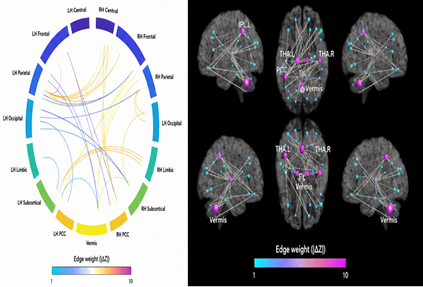
[Figure 1] Reduced functional connectivity patterns in children with Autism Spectrum Disorder. Children with ASD exhibit significantly decreased functional connectivity in regions responsible for sensory relay (thalamus) and sensory integration (inferior parietal lobule) compared to typically developing controls.
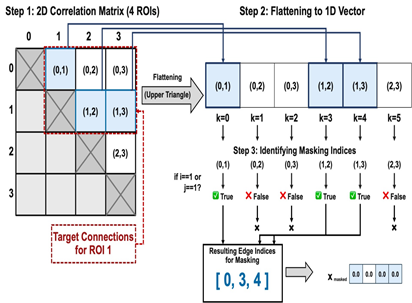
[Figure 2] Framework for evaluating latent AI representation shifts following counterfactual disconnection of specific brain regions.
An international joint research team comprising Professor Kim Bung-Nyun(Research Professor Lim You-bin), Department of Child and Adolescent Psychiatry at Seoul National University Hospital, Principal Researcher Han Kyung-reem(Postdoctoral Researcher Kang So-hyun), Brain Science Institute at Korea Institute of Science and Technology, and Professor Han So-yeon(Researcher Chung Hyun-suk), School of Computing and Information Systems at University of Melbourne has proposed a novel evidence-based AI framework. This framework evaluates whether information learned by AI models from functional magnetic resonance imaging (fMRI) accurately reflects biologically meaningful brain properties. The research findings were presented at ACM SIGKDD 2026, the world's premier academic conference in AI and data mining.
* ACM SIGKDD: Association for Computing Machinery Special Interest Group on Knowledge Discovery and Data Mining
Notably, this study was accepted and presented in the newly launched ‘AI for Science’ track at ACM SIGKDD. This achievement represents a major milestone in leveraging AI to solve complex scientific and societal challenges. It combines SNUH’s large-scale clinical autism cohort and clinical fMRI research capabilities with the convergence research expertise of KIST and the University of Melbourne in artificial intelligence and neuroscience.
Autism Spectrum Disorder (ASD) is a neurodevelopmental disorder characterized by persistent challenges in social interaction, restricted interests, and repetitive behaviors. According to 2025 data from the U.S. Centers for Disease Control and Prevention (CDC), approximately 1 in 31 8-year-old children in the United States was identified with ASD in 2022. In South Korea, the number of registered individuals with ASD reached approximately 43,000 at the end of 2023, more than doubling over the past decade. Despite its increasing prevalence, early diagnosis and progress monitoring of ASD still rely heavily on behavioral observation due to a lack of established objective biomarkers, posing limitations for early intervention in infants and toddlers.
Professor Kim Bung-nyun’s team at SNUH has conducted extensive research into identifying and validating brain science-based ASD biomarkers. Recently, through resting-state fMRI analyses, the team confirmed that children with ASD exhibit significantly reduced functional brain connectivity compared to typically developing (TD) controls. Specifically, decreased functional connectivity was identified across global brain networks, particularly involving key hubs such as the inferior parietal lobule(which integrates sensory information) and the thalamus(which acts as a sensory relay station).
Building on these findings, the joint research team moved beyond conventional classification and regression-based AI models. They introduced a neurophysiology-grounded AI evaluation framework to assess how effectively internal representations learned by AI from large-scale fMRI data retain the structural characteristics of functional brain networks. This framework evaluates the biological and structural validity of brain representations that cannot be captured by prediction accuracy alone, offering potential candidate biomarkers for early diagnosis and treatment progress prediction in ASD.
While most diagnostic AI models are designed to maximize predictive performance, applying AI meaningfully to clinical and scientific research requires verifying that its learned representations reflect underlying physiological and pathological structures. Addressing this need, the team proposed an AI evaluation framework capable of biologically interpreting brain imaging data, even in highly heterogeneous conditions such as ASD.
The team proposed ‘Generative Manifold Auditing (GMA)’, a framework that audits how sensitively an AI model’s latent representations respond to structural variations in functional brain networks. The team constructed a 'normative brain network model' using TD control data which learned typical functional connectivity patterns. They then analyzed latent space shifts when specific brain regions (ROIs) were counterfactually disconnected (virtually lesioned). To distinguish biological network-specific responses from generic information loss, the team introduced the ‘Sensitivity Gap’ metric, which controls for perturbation size using matched random masking. This enabled a quantitative assessment of the model’s structural sensitivity to biologically meaningful network perturbations.
he proposed framework was validated on the large-scale multi-site ABIDE benchmark and an independent longitudinal clinical ASD cohort from SNUH (Korean Brain Network, KBN). Across diverse fMRI environments, the Denoising Autoencoder (DAE) generative model exhibited higher sensitivity to structural brain network changes compared to comparable models.
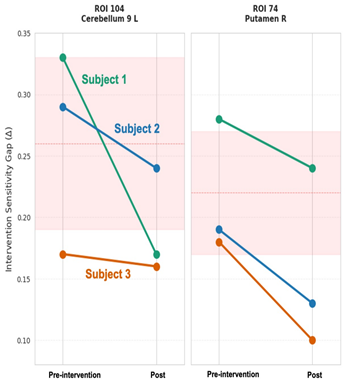
[Figure 3] Case examples illustrating that functional brain network sensitivity dynamics vary by individual even when behavioral clinical symptoms improve.
Crucially, longitudinal analysis of the SNUH cohort revealed that even when behavioral symptom severity improved (as indicated by lower K-CARS scores), neural sensitivity trajectories varied across individual subjects and brain regions. This demonstrates a dissociation between behavioral improvement and neural network dynamics. Consequently, this AI framework establishes a biological foundation for advancing precision and personalized medicine in ASD.
The research team anticipates that this study will contribute to shifting ASD research from symptom-centric approaches toward the Research Domain Criteria (RDoC) framework, which focuses on neurobiological constructs, ultimately accelerating precision medicine for ASD.
“This study provides a novel perspective for understanding and evaluating Autism Spectrum Disorder based on biological brain characteristics rather than behavioral observations alone. Moving forward, we plan to further refine this framework to utilize predicting individual treatment trajectories for patients.”, said professor Kim Bung-nyun(Department of Child and Adolescent Psychiatry at Seoul National Unversity Hospital).

[Photo from left] Prof. Kim Bung-Nyun·Research Prof. Lim You- bin(Dept. of Child and Adolescent Psychiatry at SNUH), Principal Researcher Han Kyung-reem·Postdoctoral Researcher Kang So-hyun(Brain Science Institute at Kist), Prof. Han So-yeon·Researcher Chung Hyun-suk(School of Computing and Information Systems at University of Melbourne).