Seoul National University Hospital: "Dementia Drug Choline Alfoscerate Does Not Reduce Kidney Cancer Risk"
- Based on Health Screening Big Data From 8.23 Million People... Nearly 490,000 Adults Followed for Up to 14 Years
- No Difference in Kidney Cancer Incidence Between Users and Non-Users… Confirms "Oncologic Safety," Showing the Drug Does Not Increase Kidney Cancer Risk
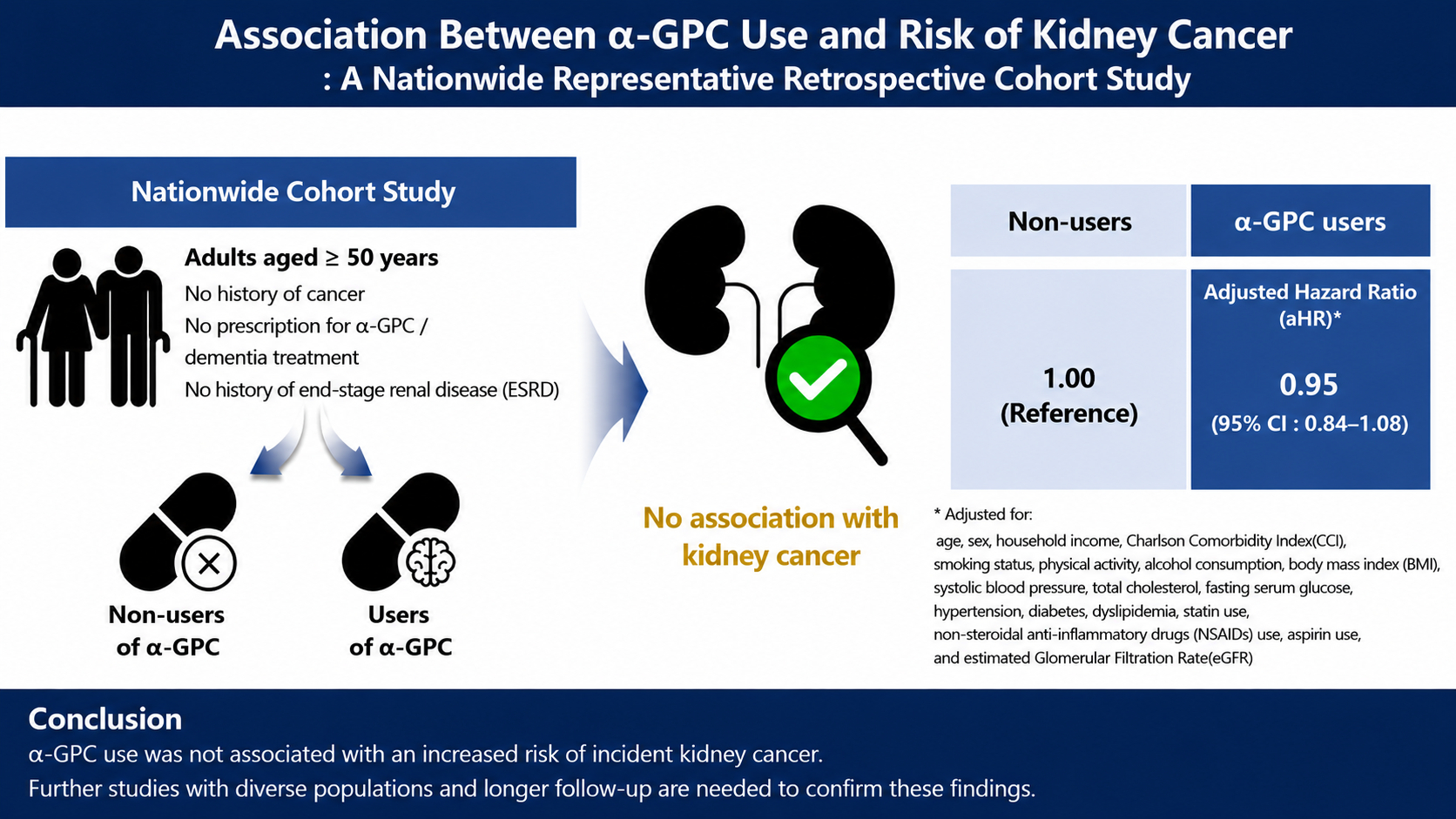
[Figure] In a nationwide retrospective cohort study of adults aged ≥50 in South Korea, use of L-α-glycerylphosphorylcholine (α-GPC, also known as choline alfoscerate) was not associated with an increased risk of kidney cancer (adjusted HR, 0.95; 95% CI, 0.84–1.08).
A research team at Seoul National University Hospital (SNUH) analyzed large-scale big data and confirmed the oncologic safety of choline alfoscerate—a drug commonly prescribed to improve cognitive function—showing that it does not increase the risk of kidney cancer. However, no preventive effect against kidney cancer was observed with use of the drug. The team explained that the protective effect against kidney cancer reported for dietary free choline, such as that obtained from eggs, cannot be directly extrapolated to choline alfoscerate.
Kidney cancer is a malignant tumor arising in the renal parenchyma or renal pelvis, accounting for approximately 2.5% of all cancers in Korea and ranking among the ten most common cancers nationwide. Renal cell carcinoma (RCC), the most common subtype, accounts for more than 90% of all kidney cancers, with advanced age, smoking, obesity, hypertension, and chronic kidney disease recognized as major risk factors. Because early-stage kidney cancer often produces no clear symptoms, it is frequently discovered incidentally during health screening or imaging tests.
Choline alfoscerate—L-α-glycerylphosphorylcholine (α-GPC)—is a cholinergic supplement widely prescribed for cognitive impairment and Alzheimer's dementia. Since insurance coverage for α-GPC was extended in South Korea in 2007, its use has risen rapidly: among newly diagnosed neurologic disease patients, including those with Alzheimer's disease, the proportion prescribed the drug increased from 16% in 2012 to 48% in 2019.
Previous research has suggested that dietary free choline intake may be associated with a reduced risk of renal cell carcinoma (RCC). However, part of α-GPC can be metabolized by gut microbiota and converted into trimethylamine N-oxide (TMAO), a metabolite that has been implicated in declining kidney function and certain cancers. Because of this, it remained unclear whether the effects observed with dietary choline would also apply to supplemental α-GPC, and no study had previously examined the direct association between α-GPC prescription and kidney cancer risk.
A research team led by Professor Sang-Min Park of the Department of Family Medicine at SNUH (with Young-Jun Park, clinical fellow, and JiWon Yu, PhD candidate at Seoul National University College of Medicine, as co-first authors) announced on the August 5th the results of a large-scale, nationwide retrospective cohort study examining the association between α-GPC prescription and kidney cancer risk, using National Health Insurance Service (NHIS) big data on 8,235,374 adults aged 50 or older who underwent national health screening in 2009–2010.
After excluding participants with a history of cancer diagnosis or end-stage renal disease (ESRD), the team classified subjects as α-GPC users or non-users based on prescription records from 2007–2010. Using 1:5 propensity score (PS) matching based on age, sex, household income, Charlson Comorbidity Index (CCI), and estimated glomerular filtration rate (eGFR), the team compared ▲81,970 α-GPC users with ▲409,801 non-users. New diagnoses of kidney cancer among these participants were tracked from 2011 to 2024, for up to 14 years of follow-up.
During follow-up, kidney cancer occurred in 1,570 non-users and 280 α-GPC users. Because the two groups differed in number of participants and length of follow-up, the team compared incidence rates standardized per 1,000 person-years—the number of cases expected if 1,000 people were followed for one year. By this measure, the incidence rate was 0.32 per 1,000 person-years in non-users and 0.30 per 1,000 person-years in α-GPC users, essentially no difference.
The result remained the same even after accounting for age, sex, and income level, as well as other factors that could influence kidney cancer risk, including smoking, alcohol consumption, obesity, blood pressure, blood glucose, diabetes, and hypertension. No statistically significant difference in kidney cancer risk was observed between α-GPC users and non-users (adjusted hazard ratio [aHR], 0.95; 95% confidence interval [CI], 0.84–1.08).
This finding remained consistent across a range of statistical analyses. No significant association between α-GPC prescription and kidney cancer risk was observed when cumulative prescription duration was divided into less than 180 days and 180 days or more (aHR, 0.93 and 1.01, respectively), when lag-time sensitivity analyses of 1 to 7 years were applied to account for the latency period of cancer development, or in subgroup analyses.
Young-Jun Park, clinical fellow, and Ji-Won Yu, researcher (co-first authors), said, "Choline alfoscerate is widely prescribed among older adults in Korea to improve cognitive function." They added, "We confirmed that the potential protective effect observed with dietary choline does not directly apply to the pharmaceutical form, α-GPC."
Professor Sang-Min Park of the Department of Family Medicine (corresponding author) said, "Using large-scale big data covering the majority of the Korean population, this is the first study in Korea to confirm the oncologic safety of choline alfoscerate with respect to kidney cancer risk, which carries significant clinical meaning." He emphasized, "However, since there is no evidence to support using it for kidney cancer prevention, the safety of choline alfoscerate should continue to be evaluated through further studies in diverse populations with longer-term follow-up."
The findings were published in a recent issue of the international journal Cancer Epidemiology.

[Photo, from left] Professor Sang-Min Park and Young-Jun Park, Clinical Fellow, Department of Family Medicine, Seoul National University Hospital; Ji-Won Yu, PhD candidate, Department of Biomedical Sciences, Seoul National University College of Medicine
■ Reference
Kidney cancer: https://www.snuh.org/health/nMedInfo/nView.do?medid=AA000368