SNUH Elucidates Mechanism of EZH1 Q571R Mutation Driving Thyroid Cancer
- Aberrant chromatin compaction → Blockade of tumor suppressor gene expression → Promotion of tumor growth
- Comparison with EZH2 Q570R mutation... Chromatin compaction capacity identified as the key to cancer growth
A recent study has revealed that the EZH1 Q571R mutation, commonly found in thyroid cancer, promotes cancer cell growth by blocking the expression of major tumor suppressor genes. The ability of this mutation to compact chromatin was confirmed as a critical factor in driving cancer progression.
As of 2023, thyroid cancer had approximately 587,000 prevalent cases in South Korea, accounting for 21.5% of all cancer patients and representing the highest proportion among all cancer types. Although the 'EZH1 Q571R mutation'—a variant of the EZH1 protein that represses gene expression—has been frequently detected in follicular and oncocytic thyroid cancer patients, its precise impact on cancer initiation and progression had not been sufficiently investigated.
A joint research team led by Professor Lee Chul-hwan(Department of Pharmacology, Seoul National University College of Medicine), Professor Lee Kyu-eun(Department of Breast and Endocrine Surgery, Seoul National University Hospital), and Professor Ryu Je-kyung(Department of Physics and Astronomy, Seoul National University), along with student researchers Kim Han-byeol, Kim Do-gyun, and Ha Seong-yun, uncovered the molecular mechanism of the EZH1 Q571R mutation using thyroid cancer patient tissues and cell lines.
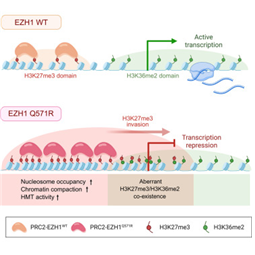
[Figure] Molecular mechanism of EZH1 and the EZH1 Q571R mutation. Under wild-type EZH1 conditions (top), repressive and active histone mark domains remain distinctly separated, allowing normal gene expression. In the presence of the EZH1 Q571R mutation (bottom), repressive marks invade active mark domains, aberrantly co-existing and suppressing gene expression.
These findings were consistently observed in actual patient tissues and animal models. In patient tissues harboring the EZH1 Q571R mutation, the expression of tumor suppressor genes was significantly decreased. In animal experiments, the mutation accelerated tumor growth by approximately 34% compared to the wild-type.
Furthermore, to understand why mutations in EZH2—a homologous protein to EZH1—are rarely found in thyroid cancer, the research team performed magnetic tweezers assays. The results showed that although the EZH2 Q570R mutation exhibits increased catalytic activity, it possesses low chromatin compaction capacity, resulting in a lower risk of driving tumorigenesis. The researchers explained that chromatin compaction capacity serves as the primary driver of cancer growth.
Professor Lee Chul-hwan(Department of Pharmacology at Seoul National University College of Medicine) stated, "The greatest significance of this study lies in explaining the functional mechanism of the EZH1 Q571R mutation at the molecular level. Moving forward, we plan to extend our research toward therapeutic strategies targeting the biological mechanisms of epigenetic mutations".
Professor Lee Kyu-eun(Department of Breast and Endocrine Surgery at SNUH) emphasized, "This study has confirmed that the EZH1 Q571R mutation blocks tumor suppressor gene expression and accelerates tumor growth, proving that chromatin compaction capacity is the key determinant driving this process".
Professor Ryu Je-kyung(Department of Physics and Astronomy at Seoul National University) noted, "By integrating medicine, biology, omics, and physics, we successfully demonstrated for the first time that the EZH1 Q571R mutation enhances chromatin compaction using single-molecule biophysical techniques, marking a meaningful achievement".
Meanwhile, this study was published in the latest issue of the international academic journal Molecular Cell (IF 16.0).
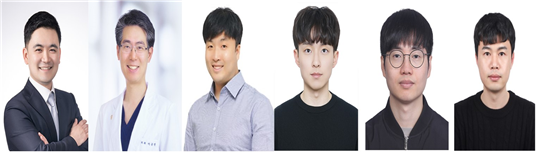
[From left] Professor Lee Chul-hwan(Department of Pharmacology at SNU College of Medicine), Professor Lee Kyu-eun(Department of Breast and Endocrine Surgery at SNUH), Professor Ryu Je-kyung(Department of Physics and Astronomy at SNU), and student researchers Kim Han-byeol, Kim Do-gyun, and Ha Seong-yun.