Diabetes and Obesity Drug ‘Semaglutide’ Shows Potential to Lower Risk of Adult-Onset Seizure
- Joint international research team led by Seoul National University Hospital analyzed approx. 18,000 type 2 diabetes patients from a large-scale U.S. cohort
- 4-year cumulative seizure risk decreased by 1.78%p and 1.46%p compared to other glucose-lowering drugs and SGLT2 inhibitors, respectively
- Impact of blood glucose and weight reduction was minimal… suggesting Semaglutide’s protective potential for brain health
A large-scale, population-based study has shown that Semaglutide, widely used as a treatment for type 2 diabetes and obesity, can significantly lower the risk of adult-onset seizures.
"Adult-Onset Seizure" refers to seizures that occur for the first time after age 18. New-onset seizures in middle-aged and older adults are drawing attention as a crucial indicator of brain health, as they can be associated with acquired brain injuries such as stroke, neurodegenerative diseases, and traumatic brain injury. Once a seizure occurs, patients face risks of loss of consciousness and falls, as well as restrictions on driving and social activities, severely impacting their functional prognosis and quality of life. However, current treatment options are limited to suppressing recurrence with anti-seizure medications after a seizure has already occurred, with no fundamental disease-modifying strategy to prevent the onset of seizures.
A joint research team—comprising Professor Yun-Hyeok Jang and Professor Soone-Tae Lee from the Specialization Center for National Strategic Technology and the Department of Neurology at Seoul National University Hospital, Professor Yong Eun from the Department of Internal Medicine at Columbia University, and Su Hwan Bong, a Ph.D. candidate at the Harvard T.H. Chan School of Public Health—announced the findings of their study analyzing the association between Semaglutide administration and the incidence of adult-onset seizures on the 23rd.
The target drug of the study, Semaglutide, is a therapeutic agent that has demonstrated protective effects across multiple clinical domains. The American Diabetes Association (ADA) recommends it as a first-line therapy for type 2 diabetes patients at high risk of cardiovascular disease, and it is already widely prescribed for metabolic dysfunction-associated steatohepatitis (MASH) and chronic kidney disease, as well as blood glucose and obesity management.
The research team utilized electronic medical record (EMR) data from the "All of Us Research Program," a large-scale healthcare cohort by the U.S. National Institutes of Health (NIH). After screening 69,228 patients with type 2 diabetes out of approximately 390,000 individuals with available data, they analyzed the risk of adult-onset seizures in 18,243 adult patients aged 18 and older (mean age approximately 60–64 years) who were newly prescribed Semaglutide, other glucose-lowering drugs, or SGLT2 inhibitors.
To ensure an accurate comparison, the researchers applied the "Target Trial Emulation" methodology to mimic a randomized controlled trial using observational data. They established two comparison cohorts: ▲Semaglutide vs. Other Glucose-Lowering Drugs (10,213 patients) ▲Semaglutide vs. SGLT2 Inhibitors (8,605 patients). They precisely adjusted for clinical differences, including age, comorbidities, and body mass index (BMI), to evaluate the drug's effect.
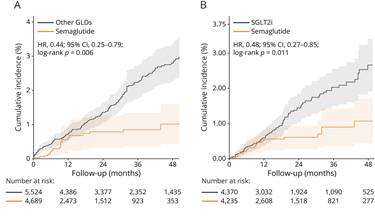
[Figure] Risk of adult-onset seizure remained low during Semaglutide administration. The 4-year cumulative risk difference was confirmed to be 1.78%p compared to other glucose-lowering drugs (A) and 1.46%p compared to SGLT2 inhibitors (B).
The results showed that the new Semaglutide user group had an approximately 56% lower risk of developing adult-onset seizures compared to the group taking other glucose-lowering drugs (Hazard Ratio [HR] 0.44). The "4-year cumulative risk difference," representing the actual difference in seizure incidence rates, was 1.78 percentage points. In the comparison with SGLT2 inhibitors, the Semaglutide group also showed a 52% lower seizure risk (HR 0.48), with a 4-year cumulative risk difference of 1.46 percentage points.
Converted into the clinical efficacy metric Number Needed to Treat (NNT), treating 70 and 131 patients with Semaglutide instead of other glucose-lowering drugs or SGLT2 inhibitors, respectively, would prevent one additional case of adult-onset seizure.
Notably, the reduction in seizure risk could not be explained solely by blood glucose or weight reduction. Mediation analysis revealed that changes in HbA1c accounted for only 2.4% to 6.5% of the effect, while changes in BMI accounted for only 0% to 0.7%. Furthermore, this preventive effect was not distinctly observed with other GLP-1 receptor agonists. The research team suggested that this may be due to Semaglutide's unique pharmacological properties, such as its extended half-life in the body and partial ability to cross into the brain.
This study holds significant value by demonstrating, through large-scale population data, the potential for metabolic disease treatments to contribute to brain health and the prevention of neurological disorders in a field where preventive strategies have been limited.
"This study views adult-onset seizures from a new perspective centered on brain health in middle and older age. However, as this is an observational study, future long-term follow-up studies and randomized clinical trials are required to confirm its actual preventive efficacy and clinical applicability.", said Professor Jang Yun-hyeok(Specialization Center for National Strategic Technology·Department of Neurology).
The findings of this study were recently published in Neurology, the official medical journal of the American Academy of Neurology.

[Photo] Professor Jang Yun-hyeok(Specialization Center for National Strategic Technology·Department of Neurology).