“Health is an Asset”... Office Workers with Good Mental and Spiritual Health Open Their Wallets More for Health Management
- Seoul National University Hospital Research Team Survey Results on Perceptions of ‘Health Asset Value’ Targeting 1,000 employees Aged 20-40
- 8 out of 10 employees Say “Health Asset Assessment Helps with Management”... 63.4% Say “Will Participate Even If It Costs”
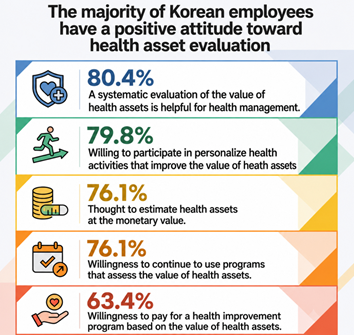
▲ Results of the 2024 survey on Korean employees perceptions of health asset value (N=1,000)
Amidst growing interest in the view that individual health is a ‘health asset’ with investment value that creates economic growth and social value, most Korean employees expressed positive attitudes toward health asset valuation and were willing to pay for health improvement programs based on the value of their health assets. Notably, willingness to pay was more strongly associated with mental and spiritual health status than with socioeconomic factors such as income.
A research team led by Professor Young-Ho Yun of the Department of Family Medicine at Seoul National University Hospital, in collaboration with the Seoul National University Health Culture Initiative, investigated perceptions and potential implications of Health Asset Valuation (HAV) among 1,000 Korean employees aged 20–49 years nationwide. The findings were published in the latest online edition of the international journal Scientific Reports.
"Health assets" refer to any factors or resources that enhance the ability of individuals, communities, organizations, populations, or social systems to maintain and sustain health and well-being. Unlike conventional approaches that focus on identifying disease and health deficits, the health asset approach considers a broad range of determinants—including genetic, medical, behavioral, social, and environmental factors—that support health. Based on this concept and previous research, the research team defined Health Asset Valuation (HAV) as a method of measuring the value of an individual’s health assets by combining self-rated current health status with annual income. The aim is to motivate individuals to take better care of their health and to help address health inequalities across socioeconomic groups.
To explore public perceptions and potential implications of HAV, the research team conducted a nationwide survey of 1,000 Korean employees aged 20–49 years living across 17 major cities and local districts. Participants rated their agreement on a four-point Likert scale regarding five aspects of health asset valuation: ▲considering health assets to have an economic value ▲considering a systematic evaluation of health assets to be helpful for health management ▲willingness to continuously use programs that assess the value of health assets ▲willingness to participate in personalized health improvement activities that increase the value of health assets ▲willingness to pay for health improvement programs based on the value of health assets.
The survey showed that most Korean employees had positive attitudes toward health asset valuation. Specifically, 80.4% agreed that a systematic evaluation of health assets is helpful for health management. More than 70% also expressed positive attitudes toward willingness to participate in personalized health improvement activities that increase the value of health assets (79.8%), considering health assets to have an economic value (76.1%), and willingness to continuously use programs that assess the value of health assets (76.1%). In addition, 63.4% indicated a willingness to pay for health improvement programs based on the value of health assets. These findings are consistent with a previous nationwide survey conducted in 2021, in which 66.0%–85.8% of respondents expressed positive attitudes across all five HAV domains.
The research team also assessed participants' self-rated physical, mental, social, spiritual, and overall health, along with socioeconomic characteristics such as educational attainment and monthly household income, to examine how attitudes toward Health Asset Valuation (HAV) differed according to health status and socioeconomic characteristics.
As a result, among the health domains examined, mental and spiritual health were significantly associated with positive attitudes toward HAV. Participants with good-to-excellent mental health were 1.42 times more likely to express willingness to pay for health improvement programs based on the value of health assets than those with poorer mental health. Participants with good-to-excellent spiritual health who are finding meaning in life through volunteer work, religion, meditation etc were 1.45 times more likely to recognize the economic value of health assets, 1.42 times more likely to perceive the usefulness of health asset valuation, and 1.51 times more likely to express willingness to pay than those with poorer spiritual health. The research team interpreted these findings to suggest that employees who place greater value on intangible dimensions of health, such as mental and spiritual well-being, are more receptive to evaluating and utilizing the value of health assets. In contrast, physical health, social health, and overall health status were not significantly associated with attitudes toward Health Asset Valuation.
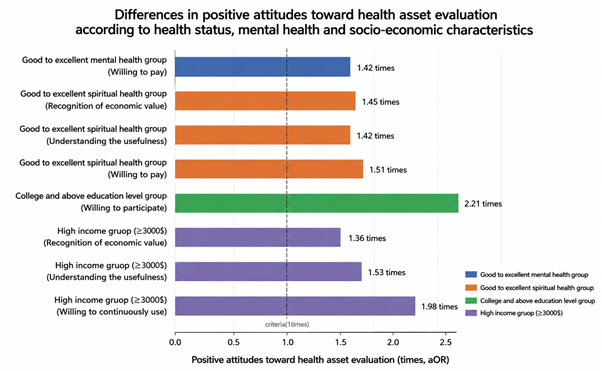
[Figure] Differences in positive attitudes toward health asset evaluation according to health status and socioeconomic characteristics. Participants with good to excellent mental or spiritual health, higher educational attainment, or higher income showed more positive attitudes toward health asset evaluation than their counterparts.
Socioeconomic characteristics were also significantly associated with attitudes toward Health Asset Valuation (HAV). Participants with a college education or higher were 2.21 times more likely to express willingness to participate in personalized health improvement activities that increase the value of health assets. Employees with higher income were 1.36 times more likely to recognize the economic value of health assets, 1.53 times more likely to perceive a systematic evaluation of health assets as helpful for health management, and 1.98 times more likely to express willingness to continuously use programs that assess the value of health assets. In contrast, no significant associations were found with sex, age, or company size (large enterprises versus small and medium-sized enterprises).
Professor Young-Ho Yun (Director of the Gangnam Center at Seoul National University Hospital) said, “Because employees’ working environments are closely linked to their health, both governments and employers should recognize workers’ health not merely as a welfare cost but as a valuable health asset worthy of investment.” He added, “We hope these findings will provide a basis for developing multidimensional Health Asset Valuation (HAV) and personalized health programs, as well as for establishing policies to reduce health inequalities across socioeconomic groups and regions.”

[Photo] Professor Young-Ho Yun (Department of Family Medicine)