Seoul National University Hospital Identifies Increased Neurodegeneration-Related Tau Accumulation in the Brains of ‘Dementia-Free’ Patients with Epilepsy
- Accumulation of signals related to 'tau,' a key protein in neurodegenerative diseases, observed in actual patient brain imaging (PET).
- “A pathological phenomenon independent of Alzheimer’s disease”... Disease burden of epilepsy linked to systemic aging
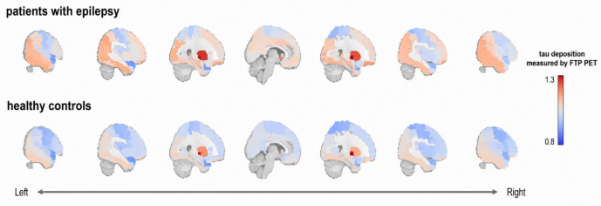
[Figure] Comparison of tau PET images between patients with epilepsy and healthy controls. Significantly greater cortical tau PET signal, indicative of tau deposition, was observed throughout the cerebral cortex of dementia-free patients with epilepsy (top) than in healthy controls (bottom).
A research team at Seoul National University Hospital found that patients with epilepsy who had neither dementia nor subjective cognitive decline exhibited significantly greater cortical tau PET signal than healthy controls. This finding is particularly significant because it demonstrates in vivo that epilepsy itself may be associated with neurodegeneration-related pathological changes even in the absence of clinically apparent dementia. The findings of this study were published in the online edition of the international journal Brain.
While tau normally supports the cytoskeleton within brain cells, it forms "neurofibrillar knots" that destroy nerve cells when they abnormally tangle, making it a major cause of neurodegenerative diseases such as Alzheimer's disease. Although epilepsy and dementia have long been regarded as distinct conditions, recent animal experiments and analyses of patient brain tissues have begun to reveal clues suggesting that epilepsy may promote tau accumulation. However, it has not been sufficiently determined whether tau actually accumulates in epilepsy patients without dementia, or what relationship this has with clinical symptoms.
Accordingly, a research team led by Professors Sang-Geon Lee and Geon Joo of the Department of Neurology and Professor Hong-Yoon Choi of the Department of Nuclear Medicine at Seoul National University Hospital (first authors: Clinical Instructor Sang-Bin Hong of the Department of Clinical Genomics and Professor Yong-Won Shin of the Department of Critical Care Medicine) conducted tau PET, amyloid PET, and blood proteomic analyses on 75 epilepsy patients without dementia diagnoses or memory impairments and 47 healthy control subjects.
The analysis results showed that tau PET signals were significantly higher across the cerebral cortex in epilepsy patients compared to the control group. In blood tests, the rate of phosphorylated tau levels, associated with tau pathology, exceeding the reference threshold reached 24%, approximately five times higher than that of the control group (5%). On the other hand, there was no significant difference between the two groups regarding amyloid protein, another cause of early Alzheimer's disease. Furthermore, the distribution pattern of tau PET signals differed from that of Alzheimer's disease, confirming that this phenomenon is a pathological phenomenon associated with epilepsy itself, independent of Alzheimer's disease.
This tau accumulation was more pronounced as the severity and prevalence of epilepsy increased. Tau signals were highest in patients with "multifocal epileptic discharges," characterized by abnormal electrical signals appearing in multiple brain regions, and this association persisted even after strict statistical adjustments. Tau levels also tended to be higher in patients with slowed brainwaves or those who had experienced recurring seizures since adolescence. In patients where seizures originated on only one side of the brain, tau was more concentrated in that specific area. Furthermore, tau signals were highest in patients with epilepsy that developed after encephalitis, suggesting that inflammation may be a factor promoting tau accumulation.
Moreover, it was revealed that epilepsy is not merely a disease confined to the brain but is also linked to accelerated systemic aging. Biological age estimation via blood proteomics showed that epilepsy patients exhibited accelerated aging throughout the body, including the brain, kidneys, muscles, and pancreas, and this pattern was correlated with brain tau signals. In particular, patients with higher tau signaling levels showed increased levels of proteins related to mitochondrial function and oxidative stress, while microglia-related proteins and immune cell mobilization proteins involved in processing damaging substances and inflammatory responses in the brain exhibited an inverse association with tau signaling. This suggests that tau-related changes in epilepsy patients may be intertwined not only with energy metabolism and oxidative stress but also with changes in the brain's immune and clearance systems.
The research team explained that these results have opened a new avenue for evaluating the disease burden of epilepsy using tau PET or blood markers, and have provided a basis for extending anti-tau therapeutic strategies targeting Alzheimer's disease to the treatment of epilepsy in the future. However, they added that these results do not imply that epilepsy is synonymous with Alzheimer's disease, and that large-scale, multi-center, long-term follow-up studies are needed to clarify the causal relationship.
Professor Sang-Kun Lee (Neurology) stated, “It was impressive that tau-related PET signals appeared more distinctly than expected in epilepsy patients without dementia symptoms,” adding, “It is worth noting whether tau PET can be utilized in the future as a tool to assess the risk of dementia and brain degenerative changes in epilepsy patients.”
Professor Kon Chu (Neurology) said, “This study is highly significant in that it confirmed, through the analysis of actual patients’ brain images and blood, that epilepsy is connected beyond a simple seizure disorder to changes in brain proteins and, furthermore, to systemic aging.”

[Photo from left] Professors Sang-Kun Lee and Kon Chu (Department of Neurology) Clinical Fellow Sang-Bin Hong (Department of Genomic Medicine), Professor Yong-Won Shin (Department of Critical Care Medicine), Professor Hong-Yoon Choi (Nuclear Medicine) at Seoul National University Hospital
