Seoul National University Hospital Lead Clinical Trials for Bidirectional 'Brain-to-Robot' Implants
- A flagship project under the multi-ministry advanced medical device R&D initiative, with a 30 billion-KRW budget over 7 years
- Leading brain BCI chip transplantation for central nervous system injury patients to artificially restore paralyzed bodies and cranial nerves
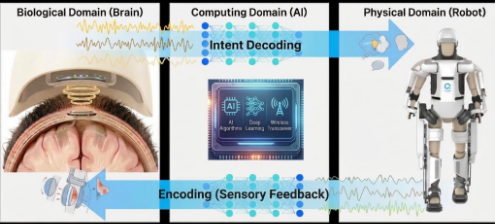
[Figure] Bidirectional Brain-to-Robot Integrated Architecture for Functional Restoration of Central Nervous System Injuries
Seoul National University Hospital (President and CEO Nam-Jong Paik) announced on the June 16th that it has joined a research and development consortium for bidirectional “Brain-to-Robot” technology, which artificially restores severed neural connections between the brain and the body to return movement and sensation to patients with central nervous system injuries. SNUH will manage the cranial nerve interface transplantation of the brain-BCI chip.
This study is a flagship project of the "Multi-Ministry Advanced Medical Device Research and Development Project." SNUH recently finalized the relevant agreement and officially commenced the research. It is a large-scale project with a total budget of approximately 30 billion KRW (including 20.25 billion KRW in government funding) spanning seven years from 2026 to 2032. It is expected to offer new hope to patients suffering from spinal cord injuries, traumatic brain injuries, strokes, and Parkinson's disease, whose conditions were previously difficult to improve with conventional treatments.
In this consortium, composed of a domestic alliance across industry, academia, research institutes, and hospitals, each institution will divide roles based on their specialized capabilities. Angel Robotics (CTO Kyoung-Chul Kong), the managing institution, will manufacture the full-body exoskeleton robot. DGIST (Professor Kyung-In Jang) and ENSIDE will develop cortical insertion electrodes, while KAIST (Professor Jung Kim) will handle somatosensory sensors and AI signal processing. Clinical trials for the brain-BCI chip implant will be led by the Department of Neurosurgery at SNUH(Professor Sun-Ha Paek). Clinical trials for the exoskeleton robot will be jointly conducted by the Department of Rehabilitation Medicine at Severance Hospital (Professor Dong-Wook Na), Gangnam Severance Hospital, Samsung Medical Center, and Pusan National University Hospital.
While Brain-to-X (B2X) technology—which controls external devices such as smartphones using electrodes implanted in the brain—has recently gained attention, the "Brain-to-Robot" technology targeted in this project represents a significantly higher level of complexity. This is because "decoding electrodes" that read behavioral intentions and "encoding electrodes" that inject physical sensations must be separately implanted into the patient's cerebral cortex. The goal of this project is to complete a fully bidirectional, closed-loop system: driving the robot with brain signals while simultaneously returning sensory information—such as the force and pressure generated during the robot's movement—back to the patient's brain within tens of microseconds(One millionth of a second).
Through this bidirectional synchronization, the ultimate aim of the project is to help patients perform daily activities while genuinely feeling sensations at their fingertips and soles, rather than just moving the robot. Currently, no case worldwide has successfully implemented a complete bidirectional system at this level.
To ensure the safe human application of this system, the Department of Neurosurgery at SNUH will utilize an advanced surgical planning system that integrates and analyzes high-resolution MRI, MRA, DTI, and PET images. This system will reconstruct each patient's brain structure and vascular map in 3D, precisely designing the optimal electrode insertion path. Furthermore, the team will develop advanced surgical strategies to implant ultra-high-density electrodes into the motor and sensory cortices. Real-time brain signal analysis during surgery will control the electrode insertion position with sub-millimeter precision, achieving world-class surgical accuracy. Furthermore, the clinical trials will thoroughly verify the safety and efficacy of the system.
The research and development will be carried out in three distinct phases. In the first phase (2026–2027), the consortium will focus on securing high-density cortical insertion electrodes and core components for the robot. The second phase (2028–2029) will involve integrating the hardware and software to advance human clinical trials. In the final phase (2030 - 2032), the project is scheduled to complete the commercialization and obtain regulatory approval from the Ministry of Food and Drug Safety (MFDS) for a "combination medical device" that integrates the cranial nerve interface, encoding and decoding AI, and the powered exoskeleton robot via ultra-low latency communication.
Professor Sun-ha Paek (Department of Neurosurgery at SNUH) said "This research goes beyond a simple medical device development project; it is a critical initiative to overcome existing technical limitations. We will do our utmost in these clinical trials to create a future where patients who have lost motor functions due to central nervous system injuries can move again, feel again, and live independent lives once more."
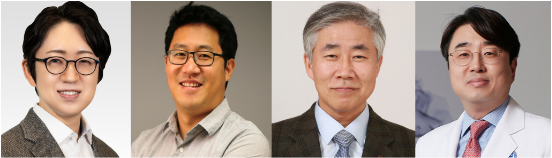
[Photo from left] Professor Kyoung-Chul Kong of KAIST, Professor Kyung-In Jang of DGIST, Professor Sun-Ha Paek of SNUH, and Professor Dong-Wook Na of Severance Hospital.
