SNUH Identifies a New Risk Factor for Cardiotoxicity in 'HER2-Positive Breast Cancer' Targeted Therapy
- Patients Positive for Clonal Hematopoiesis of Indeterminate Potential' show Increased Risk of Trastuzumab-Related Cardiotoxic Effects
- Confirmed Through Multifaceted Analysis of the UK Biobank and SNUH Cohorts... Providing a Clue to Screen High-Risk Groups Before or During the Early Stages of Treatment
‘Clonal hematopoiesis of indeterminate potential (CHIP)’ has been suggested as a new risk factor in relation to the cardiotoxicity* of trastuzumab, a targeted anticancer drug used to treat HER2-positive breast cancer.
A research team led by Professors Jun-Bean Park (Department of Cardiology) and Young-Il Koh (Department of Hematology and Oncology) from SNUH as co-corresponding authors , alongside Ph.D Gang-Pyo Ryu and Professor Chan-Soon Park (Department of Cardiology, Asan Medical Center) as co-first authors , announced the results of their study confirming the association between clonal hematopoiesis Clonal hematopoiesis of indeterminate potential and trastuzumab-related cardiotoxic effects through analyses of the UK Biobank, a Seoul National University Hospital cohort, and animal experimentation on April 17th.
Trastuzumab is a critical targeted therapeutic agent for the treatment of 'HER2-positive breast cancer,' which accounts for approximately 15% to 20% of all breast cancers. However, some patients may experience cardiotoxicity, such as left ventricular systolic dysfunction or heart failure. To date, concurrent anthracycline chemotherapy has been clearly identified as a relatively distinct risk factor, leaving a lack of predictors to screen high-risk patients prior to treatment.
Clonal hematopoiesis of indeterminate potential is a condition in which specific blood cell populations increase due to acquired genetic mutations in blood stem cells, and it has recently been attracting attention as a new risk factor associated with cardiovascular disease.
The research team hypothesized that CHIP, which increases in prevalence with advancing age , would also affect trastuzumab-related cardiotoxic effects. By integrating two human cohorts with an animal model, they intensively analyzed ▲incident heart failure risk ▲cardiotoxicity rates ▲changes in left ventricular systolic function.
Based on an analysis of 15,729 patients with breast cancer from the UK Biobank cohort, the risk of incident heart failure was highest among individuals with CHIP who were exposed to trastuzumab. Compared with the reference group (those without CHIP and unexposed to trastuzumab), the adjusted subdistribution hazard ratio (sHR) for incident heart failure was 4.57 (95% CI, 1.85-11.29).
*Adjusted subdistribution hazard ratio (sHR): An index used in survival analysis with competing risks, such as death, to evaluate the effect of covariates on the cumulative incidence probability of a specific event (cardiotoxicity).
The same trend was confirmed in 454 patients with breast cancer who received trastuzumab at Seoul National University Hospital. Based on the analysis using three cardiotoxicity evaluation criteria, the 2-year cumulative incidence values for cardiotoxic effects in the CHIP-positive group were 15.7% by the European Society of Cardiology (ESC) guidelines, 19.9% by the Canadian Trastuzumab Working Group recommendations, and 20.9% by the Cardiac Review and Evaluation Committee (CREC) criteria. These rates were significantly higher than those in the CHIP-negative group across all three definitions, which were 5.0%, 10.8%, and 11.3%, respectively. In multivariate competitive risk analysis as well, CHIP was identified as an independent risk factor (sHR 1.62–2.16 according to the definition of cardiotoxicity).
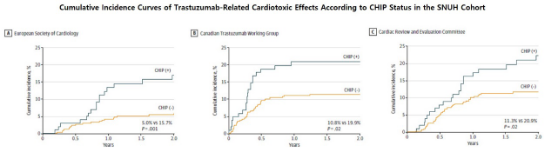
[Figure] As analyzed in the SNUH cohort using three distinct cardiotoxicity evaluation criteria (A, B, C), the 2-year cumulative incidence of trastuzumab-related cardiotoxic effects was higher in the CHIP-positive group (black line) than in the CHIP-negative group (orange line).
Consistent results were also observed in the animal experimentation. Only in a bone marrow transplant model with Tet2 deletion, a common related gene in clonal hematopoiesis, was the left ventricular ejection fraction (LVEF), which indicates cardiac contractility, significantly decreased by 4.2% after administration of trastuzumab (P=0.03).
This study is the first to combine two human cohorts with animal studies to present the association between clonal hematopoiesis and trastuzumab-related cardiotoxicity in both clinical and preclinical settings. It is expected to serve as a basis for identifying high-risk groups through the assessment of clonal hematopoiesis before or early in treatment, and for strengthening cardiac monitoring and prevention strategies.
Professor Jun-Bean Park (Department of Cardiology, SNUH) stated, "While trastuzumab is an essential drug for the treatment of HER2-positive breast cancer, it has been challenging to precisely identify patients at high risk for cardiotoxicity before starting therapy. Since this study demonstrates that clonal hematopoiesis of indeterminate potential (CHIP) can serve as a critical clue to predict patient-specific cardiotoxic risks, we expect it to guide the development of tailored cardiac monitoring and preventive strategies in the future."
Meanwhile, the findings of this study were published online in the latest edition of 'JAMA Oncology (Impact Factor: 20.1).'

[Photo: from left] Professor Young-Il Koh (Department of Hematology and Oncology, SNUH), Professor Jun-Bean Park (Department of Cardiology, SNUH), and Professor Chan-Soon Park (Department of Cardiology, Asan Medical Center).