To Focus More on Patients, Seoul National University Hospital Built KMed.AI
Clinical Practice Needs AI
Over the past two decades, hospitals have undergone rapid digital transformation. While this shift improved accessibility to medical data, it also introduced a new challenge: clinicians now spend an increasing amount of time navigating fragmented information systems rather than engaging directly with patients.
Preparing discharge summaries, reviewing medications, checking imaging studies, and verifying treatment guidelines often require searching across multiple systems and documents. In complex cases, even a single clinical decision may involve reviewing evolving guidelines, regulatory requirements, and institutional standards simultaneously.
These processes are essential for patient safety, but they also revealed an important need. At Seoul National University Hospital (SNUH), the question was never whether AI could replace clinicians. Instead, the focus became how AI could support clinicians by organizing critical information more efficiently, allowing them to make faster, safer, and more consistent decisions while spending more time with patients.
Building a Clinical AI Together
In 2023, collaboration between SNUH and Naver accelerated efforts to develop a healthcare-focused large language model (LLM) designed specifically for real clinical environments. SNUH contributed deep clinical expertise and real-world healthcare insight, while Naver brought advanced AI development capabilities.
The shared goal was not simply to create a high-performing AI model, but to develop technology that clinicians could genuinely trust and use in practice. Researchers, physicians, and engineers worked closely together to identify recurring challenges in patient care and explore how generative AI could help organize medical knowledge in a reliable and clinically meaningful way.
One of the first major outcomes of this collaboration was KMed.AI.
KMed.AI: Supporting Clinical Decision-Making
Today, KMed.AI functions as a clinical support tool that helps clinicians retrieve and organize complex medical information within a unified workflow. It can present treatment guidelines, medication information, dosing considerations, and institutional or regulatory criteria in a structured and accessible format.
Importantly, the system is designed around transparency and evidence-based support. In healthcare, responsibility for clinical decisions must always remain with clinicians. KMed.AI is therefore not intended to replace judgment, but to strengthen it by ensuring that important information is clearly organized and readily available when needed.
Beyond a Single Model: SNUH.AI
SNUH’s vision for AI extends beyond individual applications. Modern healthcare involves continuous collaboration across departments, systems, and care teams, and AI must integrate naturally into that clinical flow rather than operate as isolated tools.
To support this vision, SNUH developed SNUH.AI, an integrated platform that connects multiple AI systems, clinical data, and hospital workflows into a unified ecosystem. Within this framework, KMed.AI serves as a core generative AI engine for understanding and organizing medical knowledge, supporting functions such as clinical documentation, information review, and workflow assistance.
The ultimate objective is not simply operational efficiency. By reducing the time clinicians spend searching across fragmented systems, AI can help create more opportunities for communication, explanation, and patient-centered care. Better integration of information also improves continuity and safety throughout the patient journey.
The Future of AI at SNUH
As AI rapidly advances, healthcare requires more than the adoption of new technologies. At SNUH, SNUH.AI connects diverse AI systems, clinical data, and hospital workflows into a unified ecosystem, while KMed.AI serves as a core generative AI engine responsible for understanding and organizing medical knowledge. Together, they are helping build a more connected and patient-centered healthcare environment aligned with SNUH’s mission of promoting a healthier and happier lives for all — supporting clinicians, strengthening continuity of care, and allowing more focus on what matters most: the patient.
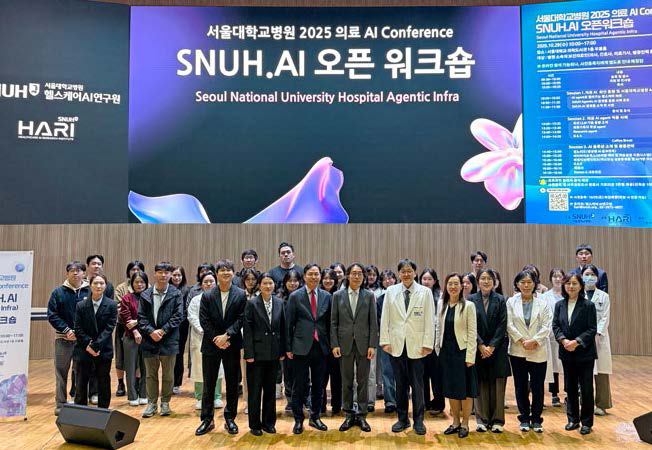
[Photo] SNUH 2025 Medical AI Conference
Hyung-Chul Lee, MD, PhD
Vice President of the SNUH Healthcare AI Research Institute and Professor of Anesthesiology.
He has led the digital transformation of healthcare through data science and artificial intelligence, and currently oversees the development and clinical implementation of KMed.ai and SNUH.AI. Through strategic collaboration with Naver, he has focused on building trustworthy sovereign AI for healthcare environments, with the goal of creating “AI that blends into healthcare like air” to support clinicians and help them focus more fully on patient care.
Hyeonhoon Lee, MD, PhD
Professor of Transdisciplinary Institute of Medicine & Advanced Technology at Seoul National University Hospital and Faculty Lead for the Technology Research Center at the SNUH Healthcare AI Research Institute.
Since 2020, he has conducted research in medical natural language processing and healthcare AI integrating clinical data with language models. His work focuses on implementing clinical AI systems that integrate biosignals, electronic medical records, and clinical knowledge, including agent-based clinical support technologies and Claim.AI, designed to reduce clinicians’ information-processing burden in real-world healthcare environments.
