SNUH Develops a Novel Fusion System for the Fundamental Treatment of Intractable Xerostomia
- Preclinical validation of an antioxidant hybrid protein cell carrier encapsulating adipose-derived MSC spheroids
- Synergistic effects of early ROS scavenging and late angiogenesis restore damaged salivary gland tissue architecture and fluid secretion function
A domestic research team has developed a new fusion treatment system capable of fundamentally treating xerostomia, a serious side effect of radiation therapy for head and neck cancer. The system operates on the principle of combining a "carrier" (protective shield) that removes reactive oxygen species-toxic substances that surge due to radiation therapy-with "stem cells" that generate new blood vessels. Animal experiments demonstrated that the initial protective action of the carrier and the later angiogenesis of the stem cells produced a synergistic effect, successfully regenerating destroyed salivary gland tissue and restoring its function within 6 weeks.
On April 27th, a research team led by Professor Seong-Keun Kwon from the Department of Otorhinolaryngology and Professor Ji-Hong Jeong from the Department of Transdisciplinary Medicine at SNUH announced that they have developed a 'stem cell spheroid-loaded antioxidant hybrid protein delivery system’ that combines biomaterials and stem cells to successfully regenerate salivary gland tissue damaged by radiation.
When patients with head and neck cancer receive radiation therapy, the radiation reacts with water inside the body, generating an overwhelming amount of toxic reactive oxygen species. This toxic surge destroys the salivary glands, leading to chronic dry mouth, known as xerostomia. As a result, essential everyday functions like chewing, digestion, and speech are severely impaired, significantly reducing the patient's quality of life. Currently, clinical options are limited to temporary fixes like artificial saliva or salivary stimulants, but no fundamental method exists to regenerate the tissues. While stem cell injections have attracted attention as an alternative, their effectiveness has been highly limited. This is because the harsh, oxidative stress environment left behind by radiation makes it difficult for the cells to survive and keeps them from remaining fixed at the injury site.
To solve this challenge, the research team combined an 'antioxidant hybrid protein delivery system’ that stably suppresses reactive oxygen species for a long period in an oxidative stress environment with a 'stem cell spheroid’ that induces new blood vessels by secreting significantly more vascular endothelial growth factor than existing 2D cultured stem cells.
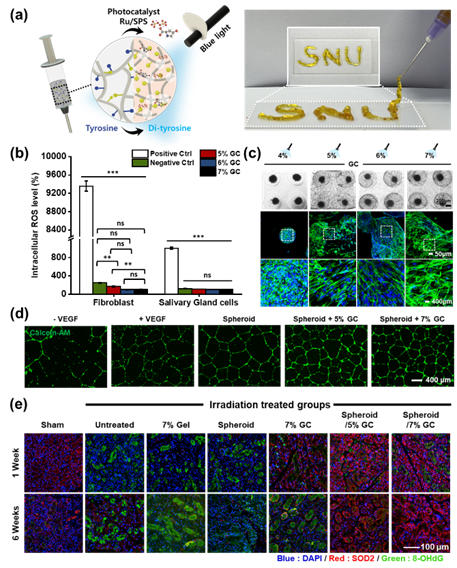
[Figure] ⓐ Overall schematic illustration of the antioxidant hybrid protein cell carrier encapsulating stem cell spheroids ⓑ Graphical analysis showing the reduction of reactive oxygen species in salivary gland cells and fibroblasts following carrier treatment ⓒ Microscopic image of the stem cell spheroids encapsulated within the carrier ⓓ Image showing neovascularization driven by the fusion therapeutic system ⓔ Tissue immunofluorescence images demonstrating increased expression of natural antioxidant enzymes and decreased oxidative stress markers after carrier injection
To implement this, the team combined glutathione-a natural antioxidant-with gelatin protein, and cured the mixture using a harmless blue light to form the protective carrier. Inside this carrier, they embedded three-dimensional stem cell clusters, packed tightly into uniform spheres measuring 300 micrometers (μm) in diameter. The survival characteristic of cells emitting stronger signaling molecules to survive when they clump together and oxygen in the center becomes scarce was actively utilized in the design of the therapeutic agent.
The research team injected this fusion therapeutic system into an irradiation-damaged mouse model and monitored the outcomes over a six-week period.
First, the newly developed carrier successfully overcame the limitations of conventional glutathione treatments, which break down far too quickly inside the body, and stably suppressed reactive oxygen species that cause oxidative stress over a long period. In fact, when a delivery carrier was administered to salivary gland cells placed in an environment of extreme oxidative stress, the rapidly increasing reactive oxygen species were significantly reduced to normal levels, and after observing for 7 days, cell death factors were also strongly suppressed to less than 4%, which is almost similar to the normal level (about 2.6%).
Concurrently, the stem cell spheroids embedded inside the carrier reacted to the low-oxygen microenvironment at their center, pumping out massive amounts of Vascular Endothelial Growth Factor. Based on the principle that this substance creates new blood vessels to supply regenerative cells and nutrients to damaged tissue, it exhibited an angiogenesis ability approximately five times higher than when treated with stem cell spheroids alone.
Consequently, in the early stage of administration, the carrier removed reactive oxygen species to prevent tissue fibrosis, and in the later stage, the stem cell spheroids generated new blood vessels, creating a synergistic effect. Through this, it was proven that the salivary gland tissue destroyed at week 6 of injection was regenerated, successfully restoring not only the actual saliva secretion volume of the mice but also normal saliva components.. In other words, a fundamental functional recovery was achieved, allowing the body to produce saliva again on its own without the need to inject artificial saliva from the outside.
Professor Seong Keun Kwon (Otorhinolaryngology) stated, "This study holds significance as it overcomes the limitations of current xerostomia treatments, which only offered temporary symptom relief, and achieves fundamental regeneration of the destroyed salivary gland tissues." He added, "We expect that the developed fusion therapeutic system will become a next-generation clinical treatment applicable to various intractable diseases that require oxidative stress suppression and angiogenesis."
The findings of this study were published in the latest issue of 'Bioactive Materials'. an international academic journal in the fields of biomaterials and medical engineering.
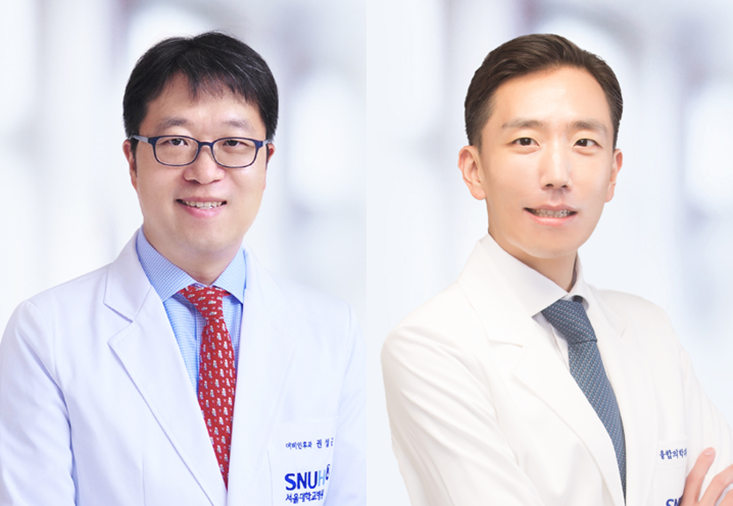
[Photo from left] Professor Seong-Keun Kwon from the Department of Otorhinolaryngology and Professor Ji-Hong Jeong from the Department of Transdisciplinary Institute of Medicine & Advanced Technology at SNUH
