SNUH Hosts 2026 Asian Brain Neuroscience Innovation Forum
- Major brain banks from Korea, Japan, and Singapore gather to discuss overcoming the limitations of Western-centric brain research data
- Participants agree on building interoperable data frameworks and Asian normative brain datasets rather than enforcing identical protocols
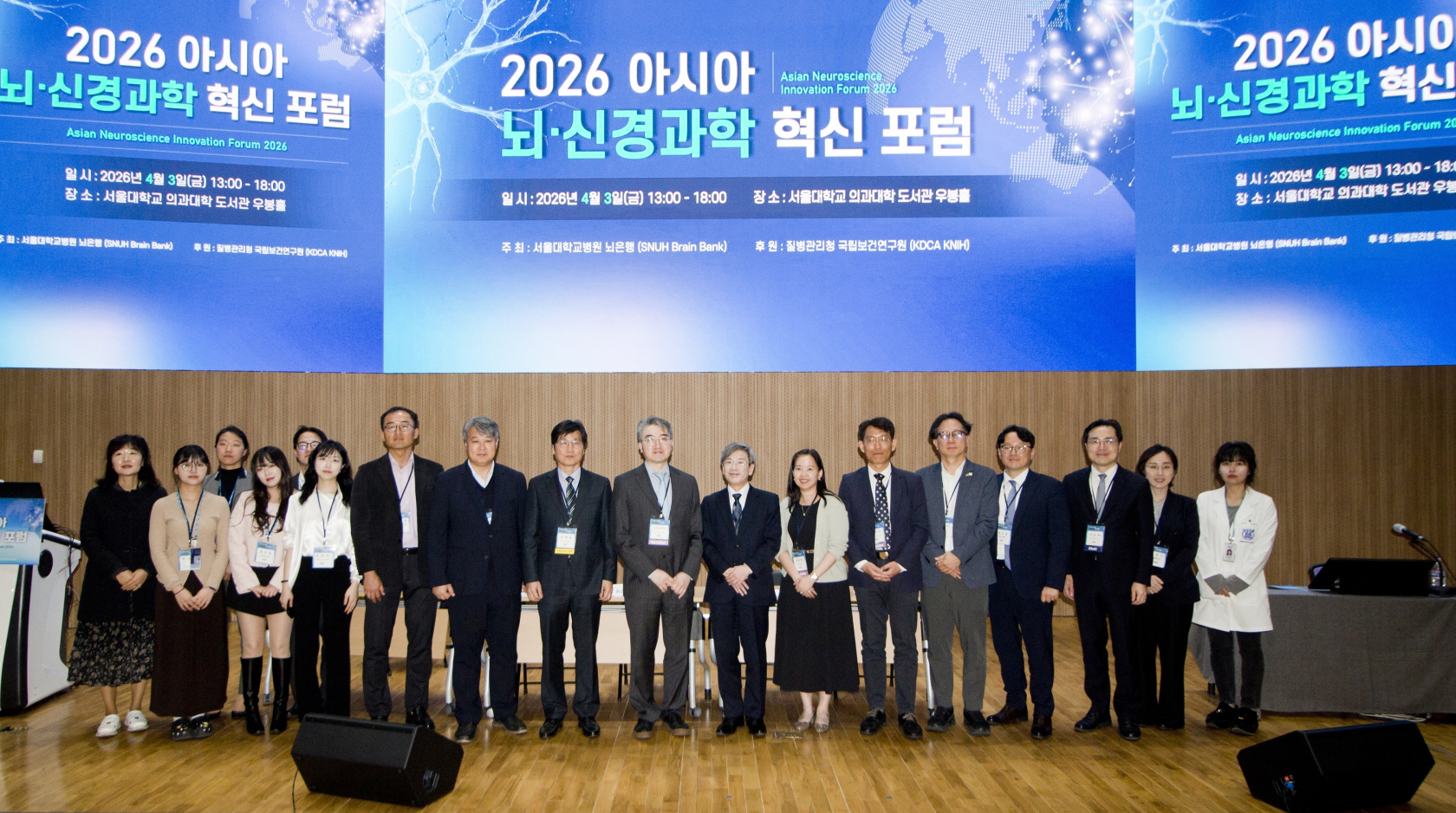
[Photo] Group photo of participants at the 2026 Asian Brain & Neuroscience Innovation Forum
Seoul National University Hospital (SNUH) Brain Bank announced that it successfully hosted the “2026 Asian Brain & Neuroscience Innovation Forum” on May 3, with support from the Korea National Institute of Health under the Korea Disease Control and Prevention Agency and the SNUH Biomedical Research Institute. The event brought together approximately 200 participants, including representatives from brain banks in Korea, Japan, and Singapore, as well as researchers from hospitals and academia and experts from the pharmaceutical, biotechnology, and AI industries to discuss collaborative strategies for brain research across Asia.
As the social burden of neurodegenerative diseases such as dementia and Parkinson’s disease, along with psychiatric disorders including depression and schizophrenia, continues to grow, researchers have increasingly recognized the limitations of relying solely on animal models to understand the complexity of the human brain. More than 80% of existing large-scale brain research datasets have been accumulated from populations in the United States and Europe, underscoring the urgent need for reference datasets that reflect the genetic and environmental characteristics of Asian populations.
In the first session, Dr. Daniel Weinberger, Director of the Lieber Institute for Brain Development (LIBD), and Dr. Juheon Shin discussed their experiences in studying brain resources from diverse populations. They highlighted the limitations of existing datasets centered on Western populations and emphasized the importance of postmortem human brain tissue research. Jae-Kyung Won, Director of the SNUH Brain Bank, then introduced SNUH’s integrated hospital-based brain bank model, covering the entire process from donor preregistration and consent to autopsy, tissue preservation, quality control, pathological diagnosis, and resource distribution to researchers.
During the second session, Dr. Akiyoshi Kakita, Director of the Niigata University Brain Bank, presented long-term clinical and pathological brain resource data and global collaboration cases, demonstrating the research value of high-quality brain specimens. Dr. Adeline Ng, Director of the Singapore Brain Bank, shared practical challenges encountered in operating a brain bank within a multicultural society, including public awareness, consent systems, postmortem tissue acquisition, and integration of clinical and pathological information. She stressed the importance of international collaboration that considers the differing circumstances of each country.
The industry session introduced advanced technologies designed to overcome current limitations in brain research. Presentations included automated technologies for stable single-cell isolation from brain tissue and spatial proteomics technologies capable of high-resolution protein distribution analysis. These technologies highlighted new opportunities for collaboration among hospitals, academia, and industry in drug development and the utilization of human brain resources.
The panel discussion that followed focused on future directions for collaboration. Professor Perminder Sachdev of the University of New South Wales also joined virtually. Participants agreed that, rather than applying a single standardized protocol across all institutions, a more realistic starting point would be to establish “interoperable data frameworks” that enable cross-comparison of samples collected under different systems. The participants also emphasized the need to jointly build an “Asian normative brain dataset” representing healthy Asian populations, laying the groundwork for precision medicine, biomarker discovery, and AI-based analysis in Asian brain research.
Jae-Kyung Won, Director of the SNUH Brain Bank and Professor of Pathology at SNUH, stated, “We hope this forum serves as a meaningful starting point for building a practical network among brain banks across Asia. Through close partnerships and sustainable collaborative research, we aim to contribute to the development of brain disease research and treatment strategies that reflect the characteristics of Asian patients.”
